Kinsman redeemer · Ancestor of David and Jesus

Boaz

PeriodEra of the Judges (~1100 BC)
Summary
Boaz was a wealthy, God-fearing landowner in Bethlehem, a relative of Naomi's deceased husband. By welcoming and marrying Ruth, the Moabite widow, he became her kinsman redeemer, father of Obed and great-grandfather of King David, entering the direct line of Jesus Christ.
Who was Boaz
Biography

Almost everyone has been on the side of depending on a stranger’s goodwill to survive, a favor no one was obligated to grant, a door that could have stayed closed. Boaz’s story begins exactly there: a foreign woman, poor and widowed, gathering leftover grain in a field that was not her own.

Boaz was a wealthy and influential man in Bethlehem, a relative of Elimelech, Naomi’s deceased husband (Ruth 2:1,3). When Ruth, the Moabite who had returned with Naomi, began gathering grain in his very fields, he already knew of her loyalty to her mother-in-law (Ruth 2:11).

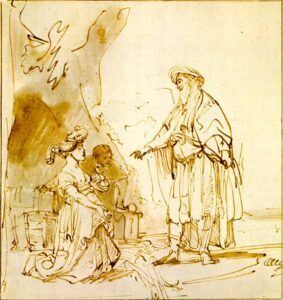
Instead of treating her as an intruder, Boaz ordered her to gather grain safely, eat with his workers, and even instructed the harvesters to deliberately drop stalks of grain for her (Ruth 2:8-16). His kindness went beyond what the law required toward the poor.

Naomi recognized something greater in this: Boaz was one of the family’s kinsman redeemers, men whom the law of Israel authorized to redeem sold land and marry the deceased’s widow to keep the lineage alive (Ruth 2:20; 3:9). At Naomi’s instruction, Ruth went by night to the threshing floor where he slept and asked him to fulfill that role (Ruth 3:7-9).

Boaz agreed, but with integrity: there was another relative with a prior right of redemption, and he only moved forward after settling the matter publicly, before the elders, at the city gate (Ruth 4:1-10). In this way he redeemed Elimelech’s inheritance and took Ruth as his wife.

From the marriage was born Obed, the father of Jesse, the father of David (Ruth 4:17,21-22). Centuries later, the Gospel of Matthew would recall that Boaz himself was the son of Rahab (Matthew 1:5), traditionally identified with the woman of Jericho who had hidden the Israelite spies (Joshua 2), uniting two welcomed foreign women in the story that leads to the Messiah.

Boaz’s life shows that quiet faithfulness, keeping the law with generosity, treating the vulnerable person with dignity, and acting with integrity when no one is checking, can be exactly the instrument God uses to weave his story of salvation. No single act of kindness seemed grand at the time; together, they formed the path to David and to Jesus.
Defining verses

The LORD repay you for what you have done. May you be richly rewarded by the LORD, the God of Israel, under whose wings you have come to take refuge.

Ruth 2:12

The LORD bless you, my daughter. This kindness is greater than that which you showed earlier: You have not run after the younger men, whether rich or poor.

Ruth 3:10

Praise be to the LORD, who this day has not left you without a guardian-redeemer. May he become famous throughout Israel!

Ruth 4:14

Visions, prophecies, and deeds

Welcomes Ruth into his field

Recognizing that Ruth was the Moabite faithful to her mother-in-law, Boaz orders her to gather grain safely, eat with his workers, and even instructs the harvesters to deliberately drop stalks of grain for her.

Ruth 2:8-16

Is identified as a kinsman redeemer

Naomi recognizes that Boaz is one of the relatives with the right and duty to redeem the land and lineage of Elimelech, reopening a hope that seemed lost.

Ruth 2:19-20

Is approached by Ruth at the threshing floor, at night

Following Naomi's plan, Ruth asks Boaz to fulfill the role of redeemer, and he praises her loyalty instead of taking advantage of the situation.

Ruth 3:6-13

Settles the right of redemption at the city gate

Before the elders of Bethlehem, Boaz gives the closer relative the first opportunity to redeem the land; when he declines, Boaz publicly takes on the commitment.

Ruth 4:1-10

Marries Ruth and redeems Elimelech's inheritance

The marriage secures an heir for Elimelech's family and lifts Ruth and Naomi out of poverty and vulnerability.

Ruth 4:9-13

Becomes David's great-grandfather and an ancestor of Jesus

The son of Boaz and Ruth, Obed, fathers Jesse, the father of David; centuries later, Matthew and Luke include Boaz in the genealogy of the Messiah.

Ruth 4:17,21-22; Matthew 1:5
Timeline
Era of the Judges (~1100 BC)

Is born in Bethlehem, son of Salmon and Rahab

According to the genealogy in Matthew 1:5, his mother was Rahab, traditionally identified with the woman of Jericho who hid the spies (Joshua 2).

Era of the Judges (~1100 BC)

Becomes a wealthy and influential man in Bethlehem

He is described as a relative of Elimelech, Naomi's deceased husband (Ruth 2:1,3).

Era of the Judges (~1100 BC)

Receives Ruth into his field during the barley harvest

Ruth begins gathering grain in Boaz's field during the harvest (Ruth 2:1-3).

Era of the Judges (~1100 BC)

Is identified by Naomi as a kinsman redeemer

Naomi recognizes Boaz as one of the family's kinsman redeemers (Ruth 2:20).

Era of the Judges (~1100 BC)

Is approached by Ruth at the threshing floor, at night

At Naomi's instruction, Ruth asks Boaz to fulfill the role of redeemer (Ruth 3:6-9).

Era of the Judges (~1100 BC)

Settles the redemption at the city gate

Before the elders, Boaz secures the right of redemption after the closer relative declines (Ruth 4:1-10).

Era of the Judges (~1100 BC)

Marries Ruth; Obed is born

The marriage produces an heir for Elimelech's lineage (Ruth 4:13,17).

Era of the Judges (~1100 BC)

Enters the lineage of David and Jesus

Obed, son of Boaz and Ruth, fathers Jesse, the father of David; Matthew and Luke include Boaz in the genealogy of Jesus (Ruth 4:21-22; Matt 1:5; Luke 3:32).

Portrait

Treated Ruth, a poor foreigner, with generosity far beyond what the law required (Ruth 2:8-16)

Publicly recognized and praised Ruth's loyalty to Naomi instead of ignoring it (Ruth 2:11-12)

Acted with integrity by giving the closer relative the first chance at redemption, even though it could have cost him Ruth (Ruth 4:1-6)

Openly fulfilled, before witnesses, a commitment he could have settled in secret (Ruth 4:9-11)

Lessons and legacy
Lessons from their life

The kindness no one requires of you can be exactly what changes another person's life

Doing the right thing openly, without shortcuts, protects your own integrity and that of those who depend on you

God weaves his story of salvation through ordinary decisions made with faith and integrity

Welcoming the vulnerable foreigner can be part of God's plan for your own family and for future generations

Missionary legacy

Boaz welcomed a Moabite foreigner in a land that viewed Moab with suspicion, a portrait of hospitality that today inspires welcoming immigrants and refugees

His story enters the lineage of Jesus alongside Rahab and Ruth, a reminder that the gospel has always included those who came from outside Israel

Boaz's practical care for a vulnerable person, food, safety and dignity, is a model for every mission that begins by meeting real needs

His public integrity at the city gate shows that mission is also sustained by transparency and justice in relationships

Family and context
Family and relationships
Father Salmon (Matt 1:5)
Mother Rahab (Matt 1:5)
Wife Ruth, the Moabite (Ruth 4:13)
Son Obed (Ruth 4:17)
Great-grandson David (Ruth 4:17,22)
Deceased relative Elimelech, Naomi's husband (Ruth 2:1,3)
Ruth's mother-in-law Naomi (Ruth 2:20)
Nations mentioned

Moab

Ruth 1:4,22

Judah

Ruth 1:1-2

Related places

Bethlehem

City of Judah where Boaz lived and owned land (Ruth 2:4)

Boaz's field

Where Ruth gathered grain behind the harvesters (Ruth 2:3)

Boaz's threshing floor

Where Ruth presented herself to him at night, at Naomi's instruction (Ruth 3:6-7)

Gate of the city of Bethlehem

Where Boaz publicly settled the right of redemption before the elders (Ruth 4:1-2)

Moab

Territory east of the Dead Sea, in present-day Jordan, Ruth's homeland (Ruth 1:4,22)

Where to find them in the Bible

Boaz's story is told in the book of Ruth, mainly in chapters 2 through 4. He also appears in the genealogies of Ruth 4:18-22, 1 Chronicles 2:11-12, Matthew 1:5 and Luke 3:32, as an ancestor of King David and Jesus Christ.

Other people