Shepherd · King · Psalmist

David

Period~1040 BC to 970 BC
Summary
David was the shepherd of Bethlehem secretly anointed by Samuel to be king, the one who defeated the giant Goliath and, later, became the greatest king of Israel. Author of much of the Psalms, his lineage carries the promise that points to the Messiah.
Who was David
Biography

Anyone who has ever been chosen for something great while still feeling too small for it knows a little of what David felt the day the prophet Samuel arrived at Jesse’s house. He was the youngest of the brothers, the one tending the sheep while the others got ready for the feast. No one expected it to be him.

Yet Samuel anointed David in secret as the next king of Israel, while he was still a boy, long before Saul left the throne. It was a calling kept quiet for years, while David went on with the sheep, learning to trust God in the ordinary routine of each day.

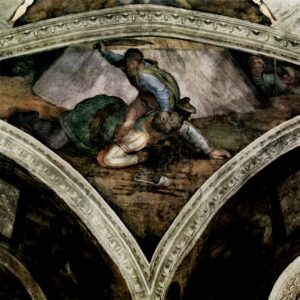
The faith trained in the field showed itself before the Philistine giant Goliath. Without armor, armed only with a sling and the certainty that the Lord fought for Israel, David struck down the one no soldier in the army dared to face.

Victory brought fame, and fame brought Saul’s jealousy. David spent years fleeing through the wilderness, hunted by the very king he served, even though he had spared Saul’s life when he could have killed him. Waiting for God’s timing, already anointed and certain of the promise, demanded patience that lasted more than a decade.

King of Judah and later of all Israel, David conquered Jerusalem and received from God a promise that would echo through the centuries: his dynasty and his throne would endure forever, a promise the Bible ties directly to Jesus.

But the same David who trusted so deeply also fell hard. He committed adultery with Bathsheba and had Uriah killed to hide the sin. When the prophet Nathan confronted him, he offered no defense, only repentance, leaving that process recorded in psalms the church still prays today.

David’s life teaches that God does not choose by appearance but by the heart, and that no sin closes the door to repentance. Anyone who feels too small or too guilty finds in David an imperfect king whom God, even so, called beloved.
Defining verses

But the LORD said to Samuel, "Do not consider his appearance or his height, for I have rejected him. The LORD does not look at the things people look at. People look at the outward appearance, but the LORD looks at the heart."

1 Samuel 16:7

Your house and your kingdom will endure forever before me; your throne will be established forever.

2 Samuel 7:16

The LORD is my shepherd, I lack nothing.

Psalm 23:1

Visions, prophecies, and deeds

The victory over Goliath

A young shepherd faces the Philistine giant without armor, trusting only in a sling and the name of the Lord.

1 Samuel 17:45-50

The friendship with Jonathan

Makes a covenant of loyalty with Saul's son, even though Jonathan was the natural rival to the throne.

1 Samuel 18:3; 20:16-17

Spares Saul's life twice

Has the chance to kill the king who hunts him and holds back, out of respect for the Lord's anointed.

1 Samuel 24:1-7; 26:7-11

The Davidic covenant

God promises that David's throne will endure forever, a promise that points to the Messiah.

2 Samuel 7:12-16

The sin with Bathsheba

Commits adultery and has Uriah killed to cover up the sin, until confronted by the prophet Nathan.

2 Samuel 11-12

The psalm of repentance

After being confronted, writes a prayer of confession that the church still uses today.

Psalm 51

Prepares the temple for Solomon

Gathers materials and plans for the house of God, though not permitted to build it himself.

1 Chronicles 22:5-16; 28:11-19
Timeline
~1040 BC

Born in Bethlehem, the youngest son of Jesse

He was tending the family's flock when he was called (1 Samuel 16:11-12).

~1025 BC

Secretly anointed by Samuel

The Lord chooses by the heart, not by appearance (1 Samuel 16:7,13).

~1023 BC

Defeats the giant Goliath

Faces the Philistine with a sling, in the name of the Lord (1 Samuel 17:45-50).

~1015 BC

Flees from Saul and lives as a fugitive

Spends years hiding in the wilderness, hunted by the very king he served (1 Samuel 19-26).

1010 BC

Becomes king of Judah in Hebron

After Saul's death in battle (2 Samuel 2:4).

1003 BC

Conquers Jerusalem and makes it his capital

The city becomes known as the City of David (2 Samuel 5:6-9).

~995 BC

Commits adultery with Bathsheba

Has Uriah killed to hide the sin (2 Samuel 11).

970 BC

Dies at an advanced age

Succeeded by his son Solomon (1 Kings 2:10-12).

Portrait

Trusted the Lord from a young age, facing Goliath without armor, armed only with a sling and faith

Spared Saul's life twice, even though he could have taken revenge, out of respect for the king anointed by God

Wrote much of the Psalms, leaving a model of sincere prayer before God

Remained faithful to Jonathan and to Saul's household even after becoming king

Repented deeply when confronted by the prophet Nathan, without making excuses

Committed adultery with Bathsheba and had Uriah killed to hide the sin

Multiplied wives and concubines, against the instruction given to the kings of Israel

Ordered a census out of pride, bringing a plague on the people

Failed to discipline his sons, which fed Absalom's rebellion

Lessons and legacy
Lessons from their life

God looks at the heart, not the appearance: this also applies to anyone who feels too small to be used

No sin is too small to confess, nor too great to be forgiven

Waiting for God's timing, even when already certain of the promise, is part of faith

Worshiping sincerely, as in the Psalms, matters more than appearing perfect

A leader's choices affect generations: neglecting one's own household has consequences

Missionary legacy

From David's line comes Jesus, the fulfillment of the Davidic covenant for all nations

David's psalms are still sung and prayed in churches of every language and people

His life shows that God calls shepherds, not only kings, to tasks that reach nations

The covenant made with David points to a kingdom that will one day gather all peoples under Christ

Family and context
Family and relationships
Father Jesse, of Bethlehem (1 Samuel 16:1)
Wife Michal, daughter of Saul (1 Samuel 18:27)
Wife Abigail (1 Samuel 25:39-42)
Wife Bathsheba (2 Samuel 11:27)
Son Solomon, with Bathsheba (2 Samuel 12:24)
Son Absalom (2 Samuel 3:3)
Friend Jonathan, son of Saul (1 Samuel 18:1)
Predecessor Saul, first king of Israel (1 Samuel 10:1)
Nations mentioned

Philistia

1 Samuel 17

Moab

2 Samuel 8:2

Ammon

2 Samuel 10

Syria (Aram)

2 Samuel 8:5-6

Edom

2 Samuel 8:13-14

Related places

Bethlehem

David's hometown, in the present-day West Bank

Valley of Elah

Where he defeated Goliath, in present-day Israel

En Gedi

Wilderness where he hid from Saul, in present-day Israel

Hebron

Where he was crowned king of Judah, in the present-day West Bank

Jerusalem

The capital he conquered and made the City of David, in present-day Israel

Ziklag

City where he took refuge among the Philistines, in present-day Israel

Where to find them in the Bible

David's story is told mainly in 1 Samuel 16 through 1 Kings 2, and revisited in 1 Chronicles 10-29. He wrote much of the book of Psalms and is mentioned hundreds of times throughout the rest of the Bible, including in the genealogy of Jesus in Matthew 1:1,6.

Other people