Nobleman of Judah · Administrator in Babylon · Survivor of the furnace

Abednego

Period6th century BC (Babylonian exile)
Summary
One of Daniel's three friends exiled in Babylon, Abednego chose to risk his life rather than bow down to an idol. Thrown into the blazing furnace by order of Nebuchadnezzar, he came out unharmed, a living testimony that God is faithful even when deliverance is not guaranteed.
Who was Abednego
Biography

Who has never had to decide alone, far from home, between fitting in and staying true to what they were taught to believe? Work, school, a new city: the pressure to blend in is real, and giving in can feel easier than resisting.

Abednego was born Azariah, in Judah. While still young, he was taken into exile in Babylon, along with his friends Daniel, Hananiah, and Mishael, after King Nebuchadnezzar invaded Jerusalem. At the Babylonian court, he received a new name, in honor of the god Nebo, and was trained to serve the empire that had subjugated his people.

Even surrounded by honors and fine food, he and his friends refused to be defiled by the king’s table. Approved before Nebuchadnezzar, they were found ten times wiser than all the magicians of Babylon. Later, at Daniel’s request, Abednego himself was appointed to administer the province of Babylon.

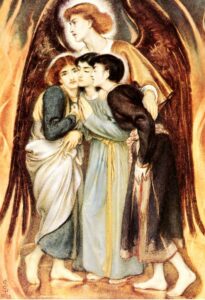
The greatest test came when the king set up a golden statue and ordered everyone to bow down before it. Abednego, Shadrach, and Meshach refused. Brought before a furious Nebuchadnezzar, they said something that still echoes today: God could deliver them from the furnace, but even if he did not, they would not worship another god.

They were thrown into the fire. Nebuchadnezzar, looking into the furnace, saw four men walking inside, unharmed, and one of them had the appearance of a son of the gods. The three came out without a single hair singed, without even the smell of smoke on their clothes.

Abednego’s faith did not depend on a guaranteed outcome. He obeyed God before knowing whether he would be rescued, and that is what makes his story so relevant today. The question is not whether the fire will come, but whether, in the middle of it, we will still be faithful.
Defining verses

If we are thrown into the blazing furnace, the God we serve is able to deliver us from it, and he will deliver us from Your Majesty's hand. But even if he does not, we want you to know, Your Majesty, that we will not serve your gods or worship the image of gold you have set up.

Daniel 3:17-18

Shadrach, Meshach and Abednego, servants of the Most High God, come out! Come here!

Daniel 3:26

Visions, prophecies, and deeds

Receives his Babylonian name

Born Azariah in Judah, he was taken into exile in Babylon and given the name Abednego, in honor of a pagan god.

Daniel 1:6-7

Refuses the food from the royal table

Together with Daniel, Shadrach, and Meshach, he avoided being defiled by the food and wine of the king of Babylon.

Daniel 1:8-16

Approved as ten times wiser

Presented to Nebuchadnezzar, he and his friends were found ten times wiser than all the magicians of the kingdom.

Daniel 1:19-20

Appointed administrator of Babylon

At Daniel's request, the king appointed him, along with Shadrach and Meshach, to administer the province of Babylon.

Daniel 2:49

Refuses to worship the golden statue

Before the whole court, he defied Nebuchadnezzar's order and declared he would rather die than worship another god.

Daniel 3:12-18

Comes out unharmed from the blazing furnace

Thrown into the fire for his refusal, he was seen walking unharmed alongside a fourth figure, and came out without any sign of burning.

Daniel 3:19-27

Promoted by the king

After the miracle, Nebuchadnezzar decreed honor to the God of the three friends and made them prosper in the province of Babylon.

Daniel 3:28-30
Timeline
~605 BC

Exiled to Babylon

Taken while still young, from the nobility of Judah, after Nebuchadnezzar's invasion.

~605 BC

Receives the name Abednego

Born Azariah, he began to be called by his Babylonian name.

~605-602 BC

Refuses the royal food

Avoided being defiled by the king's table together with Daniel, Shadrach, and Meshach.

~602 BC

Approved before the king

Found ten times wiser than the magicians of Babylon.

date uncertain

Administrator of Babylon

At Daniel's request, he was appointed to administer the province.

date uncertain

Refuses to worship the golden image

Defied Nebuchadnezzar's order before the whole court.

date uncertain

Thrown into the furnace and comes out unharmed

Witnessed God's deliverance before all of Babylon.

date uncertain

Promoted in the province

The king made him prosper, together with Shadrach and Meshach.

Portrait

Refused to be defiled by the food from the royal table, even though he was young and exiled in a foreign land

Remained firm in faith before the blazing furnace, without demanding from God a guarantee of deliverance

Kept his integrity in a position of power in the pagan court, without being corrupted by Babylonian culture

Cultivated a loyal friendship with Daniel, Shadrach, and Meshach, supporting one another in faith and prayer

Lessons and legacy
Lessons from their life

It is possible to be faithful to God even while working within a system that does not acknowledge him

Obedience to God does not depend on knowing the outcome beforehand

Friends who share the same faith strengthen one another under the worst pressures

God can be present even in the midst of the fire, without removing the believer from the trial before the appointed time

Missionary legacy

His story is read today by persecuted Christians as proof that God stands with those who suffer for not denying their faith

He served with excellence within a pagan empire without abandoning his identity, a model for Christians who live as a minority in foreign lands

His testimony before Nebuchadnezzar reminds us that the faithfulness of a few can impact entire nations

He inspires those who today face pressure to deny their faith in workplaces, schools, or governments hostile to the gospel

Family and context
Family and relationships
Original Hebrew name Azariah (Daniel 1:7)
Friend and fellow exile Daniel (Daniel 1:6-7; 2:49)
Friend and fellow exile Shadrach, also called Hananiah (Daniel 1:7)
Friend and fellow exile Meshach, also called Mishael (Daniel 1:7)
King he served Nebuchadnezzar (Daniel 1:1; 3:30)
Nations mentioned

Iraq

Babylon, where he lived in exile (Daniel 1-3)

Related places

Judah

His homeland, from which he was exiled while still young (Daniel 1:1-3)

Babylon

Present-day Iraq; the city and court where he served King Nebuchadnezzar (Daniel 1:1-7)

Blazing furnace

Where he was thrown for refusing to worship the golden image, and came out unharmed (Daniel 3:19-27)

Province of Babylon

The region he administered alongside Shadrach and Meshach (Daniel 2:49; 3:30)

Where to find them in the Bible

Abednego's story is told in the book of Daniel, mainly in chapters 1 and 3. He is also mentioned in Daniel 2:49, alongside Shadrach and Meshach, and throughout Daniel 3:28-30.

Other people