Casiodoro de Reina (c. 1520-1594) was a Spanish monk, theologian, and translator, responsible for the first complete translation of the Bible into Castilian made directly from the original languages, Hebrew and Greek. His work, known as the Bear Bible, became the foundation of the entire Spanish-language Protestant biblical tradition and the basis of the famous Reina-Valera version, still the most widely read in the Spanish-speaking world today.
Born around 1520, probably in Montemolín, in the region of Extremadura, in southwestern Spain, he entered religious life and became a monk of the Order of Saint Jerome at the Monastery of San Isidoro del Campo, near Seville. It was there that he and several fellow monks began secretly reading the writings of the Reformation and the Scriptures themselves, becoming convinced that salvation comes by grace through faith, not by merit. The community became a small evangelical center within Catholic Spain.
When the Inquisition began arresting and executing sympathizers of the Reformation in Seville, around 1557, about a dozen monks fled the country. Casiodoro led this group toward Geneva. Unsettled by the rigid climate he found there, especially after the execution of Michael Servetus, he moved on to England, where, under the reign of Elizabeth I, he pastored a congregation of Spanish-speaking refugees in London.
The Spanish Inquisition never lost sight of him. In 1562, in his absence, his works and his effigy were burned in Seville, and he was declared a fugitive heretic. Slandered also by opponents in London, he was forced to start his life over again in flight, passing through Antwerp, Frankfurt, Basel, and other cities, often in poverty and supporting his family through the silk trade.
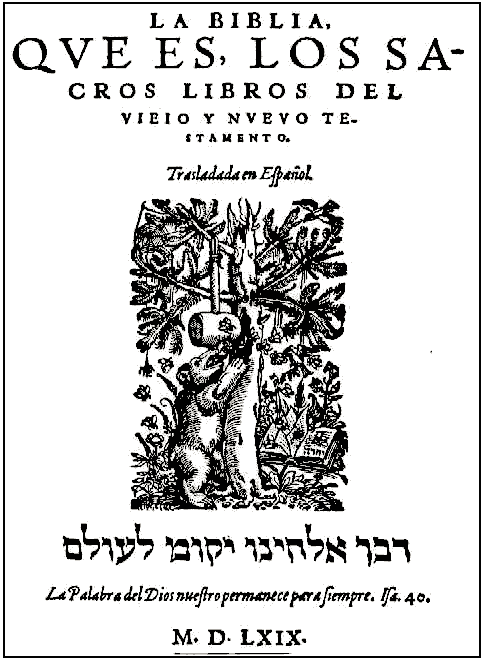
Amid persecution, upheaval, and loss, he persevered in the project that would mark his life: translating the entire Bible into everyday Spanish. The work was finally printed in Basel in 1569. It became known as the Bear Bible because of the engraving on its title page, which showed a bear seeking honey from a hive, an image of the sweetness of the Word of God.
In his final years, Casiodoro settled in Frankfurt, where he became a citizen and served as pastor to congregations of refugees, also ministering for a time in Antwerp. He died in Frankfurt in 1594. His translation was revised by Cipriano de Valera in 1602, giving rise to the Reina-Valera Bible, which for centuries nourished the faith of millions of Spanish-speaking Christians and opened the way for the gospel throughout Latin America.