It is common to live for years in the shadow of someone more visible, faithfully carrying out a quiet role, never imagining that one day you would be called to take center stage. So it was with Eleazar: the third son of Aaron, born in Egypt before the Exodus, he grew up a priest like his father and brothers, but for a long time he was not the name that stood out in the family (Exodus 6:23). This Eleazar, son of Aaron, should not be confused with other men of the same name mentioned later in the Bible; it is he, priest and later high priest of Israel, who is the subject of this page.
His older brothers, Nadab and Abihu, were the first to serve before the Lord. But they offered unauthorized fire on the altar and died before all the people (Leviticus 10:1-2). Moses ordered Eleazar and Ithamar not to tear their garments or mourn in public, so that the Lord’s wrath would not fall on the whole community (Leviticus 10:6). Almost overnight, Eleazar found himself closer to the center of the priesthood than he had ever been.
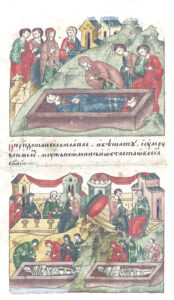
Over the course of forty years in the wilderness, Eleazar took on increasingly serious tasks. He coordinated the care of the sanctuary and its sacred utensils (Numbers 3:32; 4:16) and oversaw the rite of the red heifer, whose ashes purified anyone who touched the dead (Numbers 19:1-10). When Aaron died on Mount Hor, Moses removed his father’s priestly garments and put them on Eleazar: he became the second high priest of Israel (Numbers 20:25-28).
In the final steps of the journey, Eleazar stood alongside Moses in the final census of the people (Numbers 26:1-4) and witnessed the public commissioning of Joshua as the new leader (Numbers 27:18-23). Once in Canaan, he and Joshua divided the promised land among the tribes, casting lots before the Lord (Joshua 14:1; 19:51). Eleazar died after seeing the promise fulfilled and was buried in Gibeah, land that had been given to his son Phinehas (Joshua 24:33).
Eleazar’s life reminds us that God also uses those who never planned to be first. He did not ask for the high priesthood, nor did he ask to lose his brothers in that way, but he remained faithful in the role he had for as long as it lasted, and so he was ready when the greater calling came. For anyone who feels like just the next in line, Eleazar’s story says that faithfulness in today’s place is what prepares us for tomorrow’s place.