Prime minister · Enemy of the Jews

Haman

Period~474 BC (reign of Xerxes I)
Summary
Haman was the Persian prime minister who, stung by a single man's refusal to bow before him, tried to use his power to exterminate the entire Jewish people of the empire. His own plot turned back on him, and his downfall gave rise to the Jewish feast of Purim.
Who was Haman
Biography

Some people have almost everything, wealth, prestige, a large family, the favor of the boss, and yet a single slight can ruin the whole day. It is easy to laugh at that fragility in others and hard to recognize it in the mirror. Haman’s story is that poison magnified: what unresolved resentment can do to a heart.

Haman was a descendant of Agag and rose to the top of the Persian court. King Xerxes promoted him to a position higher than that of all the other nobles (Esther 3:1). All the palace officials had to bow before him, and everyone obeyed, except a Jew named Mordecai.

That single refusal consumed Haman. He did not want to punish Mordecai alone: he decided to exterminate the entire Jewish people of the empire, cast lots to mark the day, and persuaded the king to sign the decree (Esther 3:6; 3:13). At home, surrounded by wealth and ten sons, he confessed to his friends that none of it gave him peace as long as Mordecai lived.

His wife Zeresh suggested raising a pole to impale him, and Haman approved at once (Esther 5:14). That very night, however, the sleepless king had the chronicles of the kingdom read to him and discovered a forgotten debt to Mordecai, who had once saved his life.

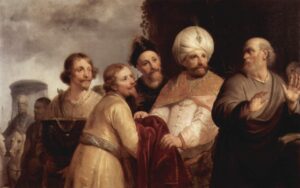
The next morning the king asked Haman how to honor a man, and Haman, certain the king meant him, suggested royal robes and a public parade. It fell to him to lead Mordecai through the streets of Susa, proclaiming aloud the honor he had planned for himself (Esther 6:6-11).

At the banquet that followed, Queen Esther revealed to the king who was plotting against her people: “The adversary and enemy is Haman, this vile man” (Esther 7:6). The king’s fury was swift, and Haman was impaled on the very pole he had prepared for Mordecai (Esther 7:10). His ten sons died afterward, and his estate passed into the hands of those he had wanted to destroy.

The book of Esther never mentions the name of God, but Haman’s downfall is proof, precisely by that silence, that he was working behind the scenes. A powerful man fell because of unresolved envy in his own heart, and that reminds today’s reader that resentment nursed in secret grows until it destroys the one who holds it. It also reminds us that even when the enemies of God’s people seem to be winning, the story is not over yet.
Defining verses

After these events, King Xerxes honored Haman son of Hammedatha, the Agagite, elevating him and giving him a seat of honor higher than that of all the other nobles.

Esther 3:1

Esther said, "The adversary and enemy is Haman, this vile man!"

Esther 7:6

So they impaled Haman on the pole he had set up for Mordecai. Then the king's fury subsided.

Esther 7:10

Visions, prophecies, and deeds

Promoted to the top of the empire

Xerxes promoted Haman to a position higher than that of all the other nobles of Persia, making him the most powerful man in the empire after the king.

Esther 3:1

Mordecai's refusal and Haman's fury

Mordecai, a Jew, refused to bow before Haman. Upon discovering that Mordecai was a Jew, Haman decided to exterminate the entire Jewish people of the empire, not just punish him.

Esther 3:2-6

Casting the pur and the decree of extermination

Haman cast lots, the pur, to choose the day of the massacre and persuaded the king to sign a decree ordering the death of all the Jews of Persia.

Esther 3:7-13

The pole prepared for Mordecai

At his wife Zeresh's suggestion, Haman had a pole fifty cubits high built to impale Mordecai.

Esther 5:14

Forced to honor his own enemy

When the king asked him how to honor a man, Haman suggested royal robes and a public parade, not knowing the man to be honored would be Mordecai. It fell to him to lead Mordecai through the streets of Susa.

Esther 6:6-11

Denounced by Queen Esther

At the royal banquet, Queen Esther revealed to the king that Haman was the author of the plot against her people.

Esther 7:6

Executed in his own trap

Haman was impaled on the pole he had prepared for Mordecai, and afterward his ten sons were also killed in Susa.

Esther 7:10; 9:10
Timeline
~474 BC

Promoted by Xerxes to the highest position in the Persian court

Esther 3:1

~474 BC

Plans the extermination of all the Jews of the empire after Mordecai refuses to bow before him

Esther 3:2-13

~474 BC

Has a pole built to impale Mordecai, at his wife Zeresh's suggestion

Esther 5:14

~474 BC

Is forced to lead Mordecai in honor through the streets of Susa

Esther 6:6-11

~474 BC

Is denounced by Queen Esther as the author of the plot

Esther 7:6

~474 BC

Executed on the pole he had prepared for Mordecai

Esther 7:10

~474 BC

His ten sons are killed in Susa

Esther 9:10

~474 BC

His estate passes to Esther and his position to Mordecai

Esther 8:1-2

Portrait

He was promoted by King Xerxes to the highest position in the Persian court, reaching the top of power as a foreigner within the empire (Esther 3:1).

He had political skill and powers of persuasion: he convinced the king to sign a decree of extermination with a single argument and an offer of money (Esther 3:8-11).

He was a meticulous planner, capable of calculating dates by lot and issuing a decree for the 127 provinces of the empire (Esther 3:7,12-13).

He built up considerable wealth and social prestige, surrounding himself with a large family and influential friends (Esther 5:11).

He let his pride, wounded by a single refusal, that of Mordecai, drive him to plan the extermination of an entire people (Esther 3:5-6).

He was incapable of contentment: even surrounded by wealth, power, and ten sons, a single frustration wiped out all his satisfaction (Esther 5:13).

He acted on impulse and vanity, assuming the king's question about how to honor someone was about himself (Esther 6:6).

He used his public office for personal revenge, putting the machinery of the state at the service of his own grudge (Esther 3:8-9).

Lessons and legacy
Lessons from their life

Unresolved resentment grows until it destroys the one who nurses it; Haman's rage against a single man ended up destroying himself.

Power and wealth are not enough to give peace to a bitter heart: he had almost everything and still lived unhappy because of a single person.

God protects his people even when he seems absent from the story; the book of Esther never mentions God's name, but his providence guides every turn of events.

Arrogance blinds: Haman assumed the king's honor would be for him and ended up proclaiming with his own mouth the glory of his enemy.

God's justice may be slow, but it does not fail: the evil Haman planned against the Jews came back upon his own house.

Missionary legacy

Haman's story reminds us that plans to exterminate God's people have arisen many times throughout history and none has ultimately succeeded, which sustains the hope of those who today work among peoples where Christians and Jews are persecuted.

The feast of Purim, created to remember the defeat of Haman's plan, is still celebrated today by the Jewish people around the world, a living testimony that the preservation of Israel remains part of God's purpose for the nations.

The account shows God acting through people in secular positions of power, Esther and Mordecai, an encouragement for Christians who serve in governments and public spheres of countries closed to the gospel.

The fall of a powerful persecutor teaches that no human opposition to the advance of God's plan among the peoples is final.

Family and context
Family and relationships
Father Hammedatha (Esther 3:1)
Wife Zeresh (Esther 5:10)
Sons Ten sons (Esther 9:10)
Ancestor Agag, Amalekite king (cf. 1 Samuel 15)
Contemporary King Xerxes I (Esther 1:1)
Contemporary Mordecai the Jew (Esther 2:5)
Contemporary Queen Esther (Esther 2:17)
Nations mentioned

Persian Empire (present-day Iran)

Esther 1:1; 3:13

Amalek

Esther 3:1 (descendant of Agag, cf. 1 Samuel 15)

Related places

Susa

Winter capital of the Persian Empire, in present-day Iran, the setting of the entire story (Esther 1:2)

Royal palace of Susa

Where Haman held office and fell into disgrace (Esther 1:2; 7:8)

Haman's house

Where he raised the pole intended for Mordecai (Esther 5:14)

Persian Empire (present-day Iran)

Domain of 127 provinces over which the decree of extermination was to be applied (Esther 1:1; 3:12-13)

Where to find them in the Bible

Haman's story is told entirely in the book of Esther, from chapter 3 to chapter 9. He is also recalled in Esther 9:24-26, in the account of the origin of the name of the feast of Purim.

Other people