c. 130-c. 202

Theologian · Bishop · Apologist

Irenaeus of Lyon

Summary
Second century Christian theologian and pastor, born in Asia Minor and bishop of Lyon, in Gaul. His work Against Heresies refuted Gnostic errors and helped establish the biblical canon and apostolic succession as criteria of genuine faith.
Who they were
Biography

Irenaeus was born around the year 130, in Smyrna, Asia Minor, today part of Turkey. As a boy, he heard the preaching of Polycarp, bishop of that city, who had been a direct disciple of the apostle John. That memory would mark his entire life.

As an adult, Irenaeus settled in Lyon, in Roman Gaul, present day France, where he served as a presbyter of the local church. There he witnessed firsthand the cost of the Christian faith before the Roman Empire.

In 177, a wave of persecution struck Lyon under the emperor Marcus Aurelius. Bishop Pothinus died as a martyr, and Irenaeus, who at that time was in Rome as an emissary of the church, returned to take up the position of second bishop of Lyon.

As a pastor, Irenaeus confronted Gnosticism, a movement that promised salvation through secret knowledge and despised material creation. He responded with the work Against Heresies, written around 180, patiently exposing the errors of these doctrines.

In that work, he argued that the Christian faith rests on the Scriptures received from the apostles and on the historical succession of bishops who guarded them, not on private revelations. He was one of the first to explicitly recognize the four Gospels as an authoritative collection.

Not all of Irenaeus’s arguments have stood the test of time. To refute the Gnostics, he argued, relying on a tradition attributed to presbyters connected to the apostle John, that Jesus had lived to nearly fifty years of age, a calculation historians today consider mistaken. Irenaeus also held the belief, common among Christians of his time, in a literal thousand year reign of Christ on earth, an idea that most of the church would later abandon.

Irenaeus also acted as a peacemaker. When Pope Victor I threatened to break communion with churches in Asia Minor over the date of Easter, he intervened, urging moderation, consistent with the meaning of his own name, which in Greek points to peace, something the historian Eusebius already noted in his Chronicle.

He died around 202, in Lyon. A later tradition regards him as a martyr, though the historical sources do not allow confirmation of the exact circumstances of his death.

Irenaeus’s legacy spans the centuries: his defense of historical revelation, the biblical canon, and the unity of the church continues to guide Christianity in the face of doctrines foreign to the gospel, in his time and in ours.
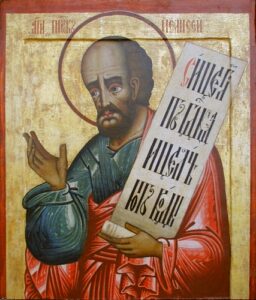
“The glory of God is a living man, and the life of man is the vision of God.”
Irenaeus of Lyon · Against Heresies, Book IV, 20:7
Timeline
c. 130

Birth in Smyrna

He comes into the world in Asia Minor, a region today part of Turkey.

c. 140-155

Disciple of Polycarp

While still young, he hears the preaching of the bishop of Smyrna, who had known the apostle John.

c. 155

Martyrdom of Polycarp

He keeps for the rest of his life the memory of his teacher, who died rather than deny Christ.

before 177

Presbyter in Lyon

He serves as a presbyter of the church of Lyon, in Roman Gaul.

177

Persecution in Lyon

Christians are killed under the emperor Marcus Aurelius, among them Bishop Pothinus.

177-178

Becomes bishop of Lyon

He takes up leadership of the church after returning from a mission to Rome.

c. 180-185

Writes Against Heresies

He systematizes the refutation of Gnosticism and the defense of the apostolic canon.

c. 190-195

Intervention in the Easter controversy

He urges moderation on Pope Victor I in the dispute over the date of the feast.

c. 202

Death in Lyon

He dies in the city where he served as bishop; a later tradition associates him with martyrdom.

Works and milestones

Against Heresies

c. 180-185

A work in five books that exposed and refuted the Gnostic systems, defending the faith received from the apostles.

Demonstration of the Apostolic Preaching

c. 190

A catechetical summary of the Christian faith, lost for centuries and rediscovered in an Armenian translation in 1904.

Second bishop of Lyon

177-178

Succeeded the martyr bishop Pothinus as head of the church of Lyon, in Gaul, after the persecution of 177.

Mission to Rome concerning Montanism

177

Carried a letter from the church of Lyon to Pope Eleutherius, asking for discernment concerning the Montanist movement.

Letter to Pope Victor I

c. 190-195

Interceded for the unity of the church in the controversy over the date of the celebration of Easter.

Testimony about Polycarp

Letter to Florinus

In a letter to Florinus, recorded personal memories of Polycarp's preaching, a link to the apostle John.

Contributions
1

Canon of the four Gospels

He was one of the first writers to explicitly defend Matthew, Mark, Luke, and John as an authoritative Gospel collection.

2

Apostolic succession

He argued that genuine faith is verified through the historical line of bishops connected to the apostles, not through secret revelations.

3

Theology of recapitulation

He taught that Christ recapitulates and restores in himself the history of humanity, begun and wounded in Adam.

4

Peacemaker among churches

He intervened in the dispute over the date of Easter, upholding unity above uniformity of customs.

Missionary legacy

His defense of Scripture and apostolic tradition as criteria of faith continues to guide missionaries facing new doctrines and syncretism.

He served as a Greek who became pastor of a Latin church in Celtic territory, an early example of cross cultural ministry.

His emphasis on the unity of the church despite local differences inspires today's dialogue between Christian traditions in missionary contexts.

The idea that the glory of God is revealed in a fully lived human life still feeds a holistic vision of mission, one that cares for the whole person.

Other people