Deacon · First martyr of the church

Stephen

PeriodEarly church in Jerusalem (~AD 34)
Summary
One of the seven deacons chosen by the church in Jerusalem to serve the widows, Stephen was full of faith, of the Holy Spirit, and of the power of God. Accused of blasphemy before the Sanhedrin, he became the first Christian martyr, stoned while praying for his spirit and forgiving his killers, in the presence of the young Saul of Tarsus.
Who was Stephen
Biography

Few things hurt as much as being punished for doing good. Stephen lived out that pain in its most extreme form: he was stoned to death for proclaiming the truth with a peace his own accusers could not explain.

He appears in the Bible as one of seven men chosen by the church in Jerusalem to oversee the daily distribution of food to the widows, a practical task that required wisdom and character (Acts 6:1-5). Stephen was described as full of faith and of the Holy Spirit, full of God’s grace and power, and he performed great wonders and signs among the people (Acts 6:5,8).

That same power stirred up opposition. Religious leaders argued with him and, unable to defeat him, brought forward false witnesses who accused him of blasphemy against Moses and against God before the Sanhedrin (Acts 6:9-13). Even so, when they looked at Stephen’s face, they saw something that seemed like the face of an angel (Acts 6:15).

Before the council, Stephen did not defend himself out of fear. He recounted the whole history of Israel, from Abraham to Solomon, showing how the people had always resisted the Holy Spirit and were now doing the same with the Messiah announced by the prophets (Acts 7:2-53). The response was fury: the leaders gnashed their teeth at him (Acts 7:54).

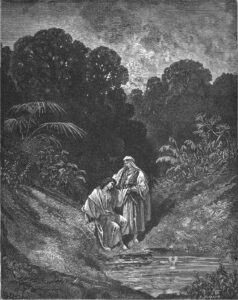
In the most tense moment, Stephen looked up to heaven and saw the glory of God, with Jesus standing at the right hand of the Father (Acts 7:55-56). The crowd dragged him out of the city and began to stone him. As the stones fell, he prayed, “Lord Jesus, receive my spirit.” Then he fell to his knees and cried out, “Lord, do not hold this sin against them” (Acts 7:59-60).

Among those guarding the coats of the men who were stoning him was a young man named Saul (Acts 7:58; 8:1). Years later, that same Saul would become the apostle Paul, and it is hard not to imagine that the scene of Stephen’s death remained etched in his memory until his encounter with Christ on the road to Damascus.

Stephen’s death reminds today’s reader that proclaiming Christ faithfully can cost dearly, and that the same Spirit who gives courage to testify also gives grace to forgive those who do harm. His final prayer echoes that of Jesus on the cross, proof that the gospel had truly transformed his heart.

Defining verses

While they were stoning him, Stephen prayed, "Lord Jesus, receive my spirit."

Acts 7:59

Then he fell on his knees and cried out, "Lord, do not hold this sin against them." When he had said this, he fell asleep.

Acts 7:60

But Stephen, full of the Holy Spirit, looked up to heaven and saw the glory of God, and Jesus standing at the right hand of God.

Acts 7:55

Visions, prophecies, and deeds

Chosen as one of the seven deacons

The church in Jerusalem chose Stephen, full of faith and of the Holy Spirit, to oversee the daily distribution of food to the widows.

Acts 6:1-5

Performed signs and wonders

Full of God's grace and power, Stephen did great signs among the people of Jerusalem.

Acts 6:8

Accused of blasphemy before the Sanhedrin

False witnesses accused him of speaking against the temple and the law of Moses, and he was brought before the religious council.

Acts 6:9-14

A face like that of an angel

Even before he spoke in his own defense, the members of the Sanhedrin already noticed something different about his face.

Acts 6:15

His speech before the Sanhedrin

He recounted the whole history of Israel to show that the people had always resisted the Holy Spirit, from the patriarchs to the prophets.

Acts 7:2-53

The vision of God's glory

At the moment of his condemnation, he saw the heavens open and Jesus standing at the right hand of God.

Acts 7:55-56

The first martyr of the church

He was dragged out of the city and stoned, praying for his own spirit and forgiving those who killed him.

Acts 7:57-60
Timeline
~AD 34

Chosen as deacon in Jerusalem

One of the seven men appointed to serve the widows in the early church (Acts 6:1-5).

~AD 34

Performs signs among the people

Full of God's grace and power (Acts 6:8).

~AD 34

Arrested and accused of blasphemy

False witnesses bring him before the Sanhedrin (Acts 6:9-14).

~AD 34

Speech before the Sanhedrin

He recounts the history of Israel and accuses the leaders of resisting the Holy Spirit (Acts 7:2-53).

~AD 34

Stoned outside Jerusalem

He dies praying for his spirit and forgiving his accusers, in the presence of the young Saul (Acts 7:58-60).

Portrait

He was full of faith and of the Holy Spirit, recognized by the church for a position of trust (Acts 6:5)

He performed signs and wonders among the people by the power of God (Acts 6:8)

He defended the faith with courage before the Sanhedrin, without shrinking back from the fear of death (Acts 7:2-53)

He forgave his killers while being stoned, following the example of Christ on the cross (Acts 7:60)

Lessons and legacy
Lessons from their life

Serving in simple tasks, like distributing food, can be God's training ground for a greater calling

It is possible to face unjust accusation with peace, because security comes from the Holy Spirit, not from human approval

Forgiving those who wrong us, even in the midst of pain, is following Christ's clearest example

The strongest opposition to the gospel can become the seed of a future conversion, as happened with Saul

Missionary legacy

His death scattered the church in Jerusalem to other regions, sparking the missionary expansion beyond the city (Acts 8:1)

His witness before the young Saul shows how God can use even persecution to prepare future missionaries

He is the first in a long line of martyrs who, throughout history, have confirmed the gospel with their own lives in difficult lands

His example of forgiveness toward his persecutors still inspires Christians today who proclaim Christ in places hostile to the gospel

Family and context
Family and relationships
Contemporary (one of the seven deacons) Philip the evangelist (Acts 6:5)
Witness to the martyrdom Saul of Tarsus, the future apostle Paul (Acts 7:58)
Nations mentioned

Egypt

Acts 7:9-22 (Joseph and Moses in Egypt)

Modern-day Iraq (Mesopotamia and the land of the Chaldeans)

Acts 7:2-4 (the calling of Abraham)

Related places

Jerusalem

Where he served as deacon, was tried, and was killed

Sanhedrin

The Jewish religious court that tried him for blasphemy

Outside the city walls

The site of the stoning, according to Jewish law (Acts 7:58)

Mesopotamia (land of the Chaldeans)

Modern-day Iraq, mentioned in the speech about Abraham's calling (Acts 7:2-4)

Egypt

Mentioned in the speech about Joseph and Moses (Acts 7:9-22)

Where to find them in the Bible

Stephen's story is recorded in Acts 6 and 7. He is also mentioned in Acts 8:2 and 11:19, and his death is recalled by the apostle Paul in Acts 22:20.

Other people