Priest · Prophet · Father of John the Baptist

Zechariah, father of John the Baptist

Period~6-5 BC (the days of Herod the Great)
Summary
An elderly, righteous priest who served faithfully for decades without seeing an answer to his prayer for a son. When he doubted the angel Gabriel's promise, he was struck mute until the birth of John the Baptist, when he regained his voice to prophesy about his son's mission.
Who was Zechariah, father of John the Baptist
Biography

Anyone who has prayed for the same thing for years without an answer, until almost giving up hope, understands something of what Zechariah lived through. He and his wife, Elizabeth, were elderly, righteous before God, and still carried the public grief of childlessness in a culture that saw children as a blessing and their absence as a shame.

Zechariah was a priest, and on that day it fell to him, by lot, to enter the temple and offer incense before the Lord, an honor that might come only once in a lifetime. It was there, beside the altar of incense, that an angel appeared.

Gabriel announced that Zechariah’s prayer had been heard: Elizabeth would give birth to a son, who would be named John and would prepare the way of the Lord. Faced with the promise, Zechariah hesitated: “How can I be sure of this? I am an old man and my wife is well along in years” (Luke 1:18).

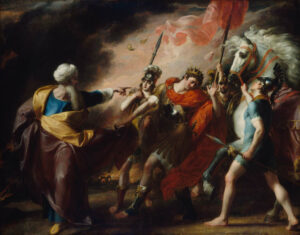
The doubt carried an immediate price: Zechariah would be mute until the word was fulfilled. He left the temple unable to speak, making signs to the people waiting outside, and went home carrying in silence the miracle already growing in Elizabeth’s womb.

Nine months later, on the day of the boy’s circumcision, the relatives wanted to name him Zechariah, after his father, but Elizabeth insisted he be called John. Asked by signs, Zechariah requested a writing tablet and wrote: “His name is John” (Luke 1:63).

At that moment his mouth was opened, his tongue was set free, and he began to speak, praising God (Luke 1:64). The first thing he did with his recovered voice was to prophesy about his son’s mission: to prepare the way of the Lord and announce the forgiveness of sins to the people (Luke 1:76-77).

Zechariah’s story speaks to anyone who has doubted a promise that took too long. God does not give up on what he has promised just because faith wavers, and the silence that unbelief imposes can end, as his did, in praise.
Defining verses

Do not be afraid, Zechariah; your prayer has been heard. Your wife Elizabeth will bear you a son, and you are to call him John.

Luke 1:13

Immediately his mouth was opened and his tongue set free, and he began to speak, praising God.

Luke 1:64

Praise be to the Lord, the God of Israel, because he has come and has redeemed his people.

Luke 1:68

Visions, prophecies, and deeds

Chosen by lot to offer incense

In what may have been the only time in his priestly life, Zechariah was chosen by lot to enter the temple and burn incense before the Lord, while all the people prayed outside.

Luke 1:8-10

The visit of the angel Gabriel

An angel appeared beside the altar of incense and announced that Elizabeth would have a son, who would prepare the way of the Lord.

Luke 1:11-17

Doubt and the silence imposed

Zechariah asked for proof of the promise and, because he did not believe, was left unable to speak until the day it was fulfilled.

Luke 1:18-20

Leaves the temple unable to speak

The people waiting outside realized, from the signs Zechariah made, that he had seen a vision.

Luke 1:21-22

The choice of the name John

On the day of the circumcision, contrary to the custom of naming the son after the father, Zechariah wrote on a tablet: 'His name is John.'

Luke 1:57-63

Healing from muteness

The moment he confirmed in writing the name John, Zechariah's mouth was opened and he began to speak again, praising God.

Luke 1:64

The prophetic song (Benedictus)

Filled with the Holy Spirit, Zechariah prophesied about God's faithfulness to Israel and about the mission of his newborn son.

Luke 1:67-79
Timeline
~6 BC

Serves in the temple and receives the visit of Gabriel

In the days of Herod the Great, he is chosen by lot to offer incense and receives the announcement of John's birth (Luke 1:5-20).

~6 BC

Becomes mute through unbelief

He leaves the temple unable to speak and returns home (Luke 1:22-23).

~6-5 BC

Elizabeth becomes pregnant and goes into seclusion

Elizabeth remains in seclusion for five months before the birth (Luke 1:24-25).

~5 BC

Birth of John the Baptist

The promised son is born, and neighbors and relatives rejoice with Elizabeth (Luke 1:57-58).

~5 BC

Circumcision and the choice of the name John

On the eighth day, Zechariah confirms in writing the name John and regains his speech (Luke 1:59-64).

~5 BC

Prophesies the Benedictus

Filled with the Holy Spirit, he announces his son's mission and God's salvation (Luke 1:67-79).

date unknown

John grows up in the wilderness

The boy grows strong in spirit until he appears publicly to Israel (Luke 1:80).

Portrait

He was righteous before God and blamelessly obeyed all the Lord's commandments, alongside Elizabeth (Luke 1:6)

He served faithfully as a priest for decades, even without seeing an answer to his prayer for a son

He obeyed the angel's instruction even after doubting, confirming in writing the name John against the pressure of relatives (Luke 1:63)

When he regained his speech, the first thing he did was praise God and prophesy about his son's mission (Luke 1:64-67)

He doubted the angel's promise even while standing before him in the temple, asking for proof (Luke 1:18)

His unbelief cost him months of silence, a public sign of his lack of faith (Luke 1:20)

Lessons and legacy
Lessons from their life

God can answer a prayer long after the one praying has stopped expecting it

Doubting God when he speaks has real consequences, but it does not cancel the promise made

Obeying God's word, even against the pressure of family and custom, opens the way for blessing

A season of forced silence can be preparation, not only punishment

Missionary legacy

His son John the Baptist prepared the way for Jesus; all mission work today follows that same pattern of preparing the ground before proclaiming the gospel

Zechariah's song announces salvation to those who live 'in darkness and in the shadow of death' (Luke 1:79), language that echoes the reach to every people that global mission seeks today

His story shows that God uses ordinary, even elderly, couples, not only the young or powerful, to prepare great movements of faith

The silent faithfulness of decades of priesthood before the miracle reminds us that the call to mission often begins in unseen, steady service

Family and context
Family and relationships
Wife Elizabeth, descendant of Aaron (Luke 1:5)
Son John the Baptist (Luke 1:13)
Wife's relative Mary of Nazareth (Luke 1:36)
Priestly division Division of Abijah (Luke 1:5)
Nations mentioned

Israel

Luke 1:16, 1:68

Related places

Temple of Jerusalem

Modern-day Israel; where Zechariah received the visit of the angel Gabriel and offered incense (Luke 1:9-11)

Hill country of Judea

Modern-day Israel; where his home was and where news of the birth spread (Luke 1:39-40, 65)

Judea under the rule of Herod

Modern-day Israel; the political setting of the account (Luke 1:5)

Wilderness

Region where John the Baptist grew up before his public ministry (Luke 1:80)

Where to find them in the Bible

The story of Zechariah, father of John the Baptist, is told in Luke 1:5-25 and 1:57-79. Apart from this account of his son's birth, the New Testament does not mention him again directly.

Other people