Missions
What Are Navaratri and Durga Puja
Understand the nine nights of Navaratri, the origins of Durga Puja, garba in Gujarat, and what Dussehra means to Hindus.

Navaratri is a Hindu celebration lasting nine nights, dedicated to the goddess, especially Durga, whom her devotees see as a mother and protector. The name comes from Sanskrit and means “nine nights.” The period brings together prayers, fasting, and gatherings, but takes different forms depending on the region.
In Gujarat, in western India, the nights are known for garba, a communal devotional dance. In Bengal, in the east, Durga Puja, an expression meaning “worship of Durga,” concentrates its main rites in the last days of this cycle. On the tenth day, Dussehra, also called Vijayadashami, celebrates victory over evil. To see how this occasion fits into the Hindu calendar, read about the most important Hindu festivals.
Durga and the origins of the celebration
The central account describes Durga confronting Mahishasura, a demon who takes the form of a buffalo and threatens the order of the world. According to Hindu tradition, the gods, unable to defeat this adversary, give their powers and weapons to the goddess. Riding a lion, she defeats Mahishasura and restores order.
One traditional explanation connects the nine nights with the length of this battle, with victory celebrated on the tenth day. Durga’s story appears in the Devi Mahatmya, a Sanskrit religious text generally dated to the fifth or sixth century. Her many arms, each holding a weapon, express her ability to confront evil.
The age of this account does not establish a single starting date for today’s festivals. In Bengal, wealthy families and landowners funded large celebrations, especially in the eighteenth and nineteenth centuries. Groups of neighbors began organizing communal pujas from the late eighteenth century, and in the early twentieth century, public neighborhood festivals spread in Calcutta, giving rise to the community Durga Puja known today.
Why devotees celebrate these nights
For those who worship Durga, the goddess’s victory affirms that evil can be defeated and that life needs protection. She represents a feminine divine force called Shakti, a word meaning energy or power. Her devotees seek support and strength to face difficulties and renew their religious lives.
The meaning also involves personal conduct. Fasting, prayers, and discipline can accompany the effort to give up anger, attachment, and greed. In different traditions, each day is dedicated to a manifestation of the goddess, but the list of these manifestations and the customs vary between communities.
In Bengal, Durga is also welcomed as a daughter returning to her parents’ home for a visit. This family image helps explain the affection shown to the goddess and the emotion surrounding her departure. Reuniting with relatives, preparing food, and welcoming visitors are part of the way people experience the festival.
From the calendar to dances and rituals
When it takes place and how it begins
The best-known celebration takes place in the Northern Hemisphere’s autumn and is called Sharad Navaratri. It begins on the first day of the waxing fortnight of the Hindu month of Ashvin, after the new moon, usually in September or October. Because the timing follows the Hindu lunar calendar, the date changes in the calendar used in Brazil.
There is also a Navaratri in the month of Chaitra, in the Northern Hemisphere’s spring, usually in March or April. The nine nights continue through the ninth lunar day, and the tenth brings the rites of victory and closure.
In many homes, the beginning includes setting up a ritual vessel, called a kalash, in a space prepared for worship. During the period, devotees pray and recite texts in praise of the goddess. Some fast every day, while others choose only certain days.
Fasting does not always mean going without food. Depending on family custom, some people stop eating rice, wheat, meat, onions, and garlic, but eat fruit, milk, and dishes permitted in their tradition. These rules do not describe all the festival’s food customs, since other communities emphasize meals and hospitality.
Garba in Gujarat
In Gujarat, groups gather at night to dance garba in communal spaces. Participants form circles, sing, and keep time with clapping and coordinated steps. At the center there may be an image of the goddess or an oil lamp, around which the dance takes place.
The circle expresses devotion to the feminine divine force and also brings people of different generations together. The music usually starts more slowly and gathers speed. The same celebrations may also include dandiya raas, a dance in which participants use small wooden sticks to keep the rhythm.
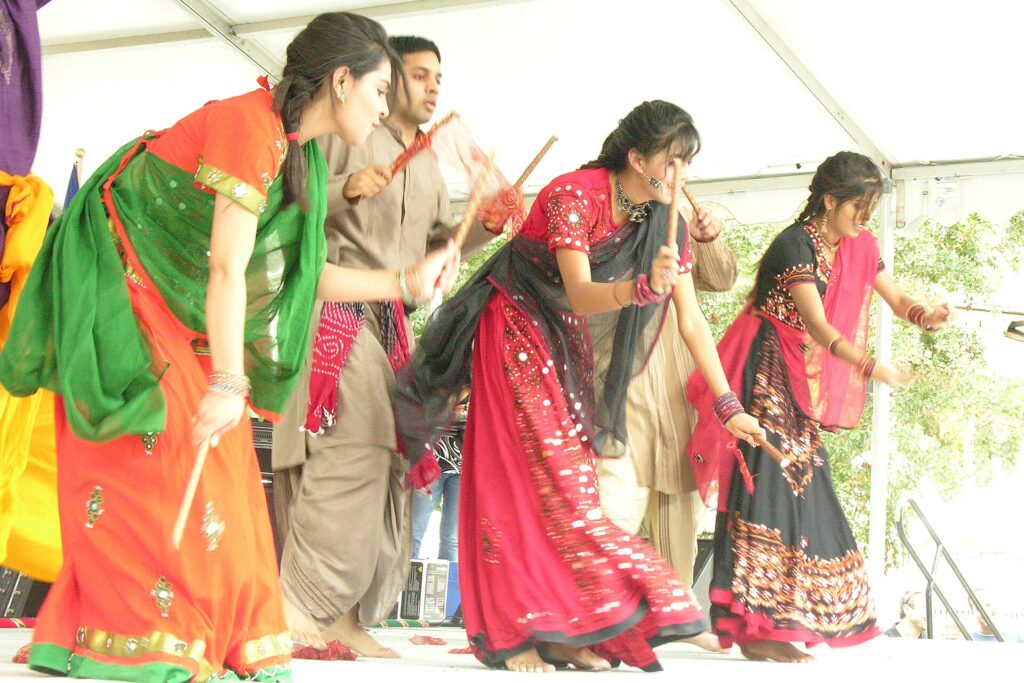
Durga Puja in Bengal
In Bengal, images of Durga are made from straw and clay, painted, and dressed for the celebration. They are placed in homes or in pandals, temporary pavilions prepared for worship and visitors. Decorating these spaces also provides an opportunity to create large works of art.
The ritual welcoming of the goddess takes place on the sixth day, called Shashthi. The following days, Saptami, Ashtami, and Navami, correspond to the seventh, eighth, and ninth days and include the main ceremonies. People pray and offer flowers, while families and groups visit different pavilions.
Food offered to the goddess, called bhog, is also shared with participants. At community celebrations, it is common to serve khichuri, a rice and lentil dish, accompanied by vegetarian dishes. The menus of particular families and traditions may differ, including fish and meat.
On the tenth day, Dashami, the images are carried in procession to be immersed in rivers or other bodies of water. For devotees, the act accompanies Durga’s farewell after her visit. Families exchange greetings, and younger people seek out their elders to receive their blessings.
Dussehra and other ways to celebrate
In other regions, especially northern India, Dussehra recalls Rama’s victory over Ravana, recounted in the Ramayana, one of the great Hindu religious works. The season includes dramatic performances of this story and the burning of large effigies of Ravana. The tenth day thus brings together distinct accounts of victory over evil.
In Tamil Nadu, in southern India, many families set up a golu, a display of dolls and figures arranged on steps. Visits to homes include singing and the distribution of gifts and food. Near the end of the period, books and musical instruments are placed before Saraswati, the goddess associated with knowledge and the arts.
Where the festival shapes community life
India brings together these different forms of celebration, with garba particularly prominent in Gujarat and Durga Puja in West Bengal. Calcutta, also called Kolkata, is a major center for the pavilions and neighborhood festivities. Durga Puja also takes place in other Indian cities, such as New Delhi and Mumbai.
In Bangladesh, Durga Puja is an important celebration for Bengali Hindus, with ceremonies in temples and community spaces, including in the capital, Dhaka. Communities abroad also keep the festival alive, as in the United Kingdom. Although the worship is Hindu, community celebrations often attract visitors who come to see the pavilions and cultural performances.
The search for protection and the gospel’s response
The celebration expresses the desire for evil not to have the final word and for life to be protected. For Christians, this search can open a respectful conversation about Jesus. Learning what the festival means to each person helps people talk without reducing someone’s faith to a cultural curiosity.
The gospel proclaims forgiveness and Christ’s victory over the powers of evil through the cross, as Paul explains in Colossians 2:13-15. Christian hope rests on what Jesus has done to reconcile people to God. This message can be shared clearly and humbly, while acknowledging differences in faith.
Getting to know peoples and praying for them
As we pray for the nations, we can remember the Bengalis of India and Bangladesh and the communities of Gujarat. We can ask that they come to know Jesus, that Christians among them live out their faith with love, and that the gospel be explained in their languages. Among unreached peoples, let us pray for opportunities to hear and understand this message.
Making a connection can begin with a conversation about what the family prepares, which gatherings they attend, and what they hope for during these nights. Listening to the answer helps us get to know the person beyond the name of their religion. Those who want to speak about Jesus can build friendships, explain their own hope, and make room for questions.
You have read this story. Now pray.
Today we pray for a nation and a people who still need to hear the gospel.
 Missions Veils, hijab and burqa: women in Islam
 Missions 2027 prayer calendar: campaigns and dates for the year
 Missions How to help persecuted Christians beyond prayer