Missions
What Is Diwali
Discover Diwali, the festival of lights: its origins, five days of celebration, meanings for Hindus, Sikhs, and Jains, and its connection with Jesus, the light of the world.

Diwali is the festival of lights, one of Hinduism’s main celebrations. Also called Deepavali, a name meaning “row of lights” in Sanskrit, it brings together glowing lamps, prayers, sweets, and family gatherings. For those who celebrate, light expresses the victory of good over evil and knowledge over ignorance.
The festival usually lasts five days, with customs that vary by region and community. Jains and Sikhs also have celebrations at this time, but with their own religious meanings. Understanding these differences helps reveal what lies behind the illuminated streets. To see how this date fits into the Hindu calendar, read about Hinduism’s most important festivals.
The stories of Rama and Lakshmi
Diwali has ancient roots in India, but there is no known founding date or single story that explains all its forms. Over time, different communities connected the festival with stories and practices of their faith. Asking about its origins therefore requires distinguishing the history of the celebration from the religious narratives that give it meaning.
In northern India, a widely known account recalls Rama’s return to the city of Ayodhya with his wife Sita and his brother Lakshmana after a long exile. Hindus regard Rama as a manifestation of the god Vishnu. According to the tradition associated with the Ramayana, the poem that tells his story, residents lit lamps to welcome the group after Rama’s victory over Ravana, the king who had kidnapped Sita.
Another tradition highlights Lakshmi, the goddess associated with prosperity and well-being. A Hindu account says she emerged when gods and other powerful beings churned an ocean of milk in search of its treasures.
Why light is at the heart of the festival
Lighting a lamp makes a hope visible: that evil, ignorance, and destructive attitudes will be overcome. The Hindu American Foundation explains that the festival brings families together and invites worshippers to commit to good choices in life. Light therefore has a moral and spiritual meaning as well as a decorative role.
The pursuit of prosperity appears in prayers to Lakshmi, but its meaning can extend beyond money. In an article published by the Hindu Life at Yale group, Asha Shipman notes that wealth is seen as temporary and should be earned, saved, and also shared for the good of the family and community. Diwali is therefore considered a favorable time for giving.
The calendar, the lamps, and the five days
The date follows Hindu calendars that combine lunar cycles with the solar year. The main night of many celebrations falls on the new moon in the Indian autumn, usually in October or November in the calendar used in Brazil, and the date changes each year. Since regional traditions vary, not everyone gives the same importance to the same day.
In homes, people light diyas, small clay oil lamps placed at entrances and in other spaces. Candles and electric lights also appear. Near doorways, many families make rangoli, designs on the ground created with colored powders, rice, or petals, as part of preparing for the festival and welcoming visitors.
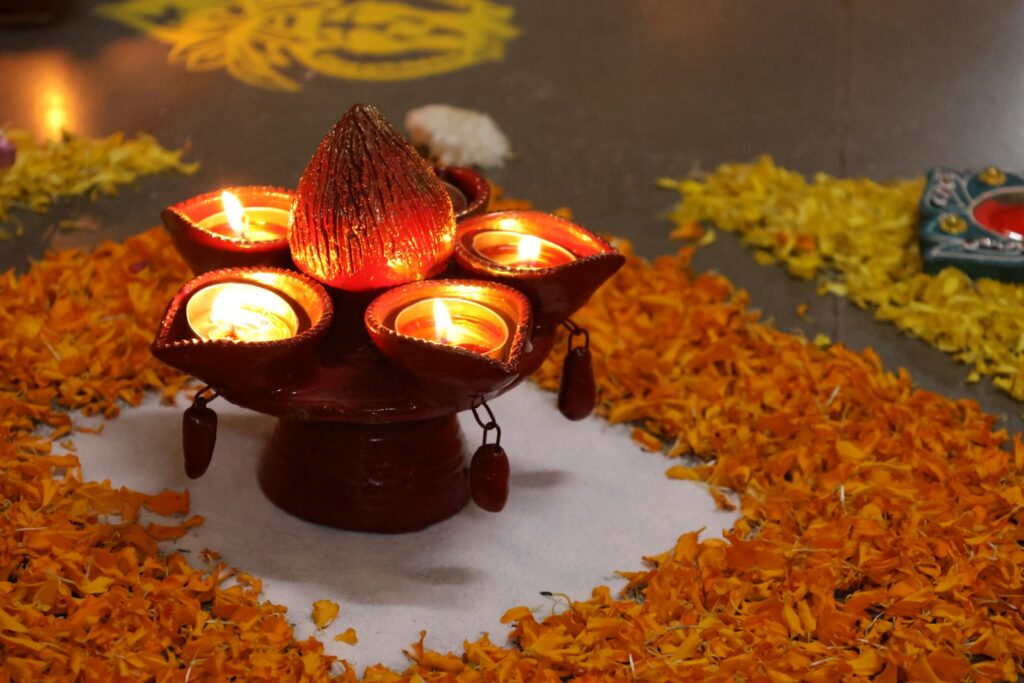
The sequence below presents one widely followed way of organizing the five days. It helps explain the celebration, although names and practices vary among communities. Some traditions include additional days of preparation during the festive period.
Day one, Dhanteras: families clean and tidy their homes, and shopping takes on a meaning connected with prosperity. Some people buy gold because they consider the occasion favorable for doing so. The day brings together practical preparations at home and anticipation of a new period of well-being.
Day two, Naraka Chaturdashi: also known in some regions as Choti Diwali, it recalls the defeat of Narakasura, an evil being, in traditions associated with Krishna. Ritual oil baths express cleansing and renewal. In parts of southern India, this is the festival’s main day.
Day three, Diwali night: many families gather for Lakshmi puja, a ceremony of worship and prayer to the goddess Lakshmi. They give thanks and ask for prosperity at home and at work. Lamps accompany this occasion, and there may also be devotion to Ganesha, who is associated with wisdom and the removal of obstacles.
Day four, Govardhan Puja: in some communities, worshippers recall the account in which Krishna lifts a mountain to protect the inhabitants from a storm. Food offerings are prepared, sometimes arranged as a mountain of food. For communities in Gujarat, in western India, this period also marks the beginning of the new year.
Day five, Bhai Dooj: the focus is the bond between brothers and sisters. In a common practice, sisters welcome their brothers, place a ritual mark on their foreheads, and express wishes for their health. Meals, sweets, and gifts accompany the gathering, strengthening family ties.
Food has an important place during the festival: sweets are prepared, bought, and offered to relatives and friends. Examples include gulab jamun and jalebi, sweets offered during the celebrations. Temple visits, new clothes, gifts, and fireworks are also part of many celebrations, according to local customs.
A festival observed by different communities
In India, Diwali fills homes, temples, markets, and public spaces, with celebrations in different parts of the country. Ayodhya is prominent because of its connection with Rama. This widespread presence does not mean uniformity: while many families worship Lakshmi, traditions in Bengal emphasize the goddess Kali on the night of the new moon.
For Jains, the date recalls the final liberation of Mahavira, one of their religion’s great teachers. According to Jain belief, he attained freedom from the cycle of birth and death. Some worshippers fast, listen to teachings, and sing hymns; the lights recall the knowledge passed on by the teacher.
Among Sikhs, the celebration of Bandi Chhor Divas takes place at this same time. It recalls the release of Guru Hargobind, a spiritual leader who, according to Sikh tradition, also secured the freedom of other prisoners. Lamps are lit in homes and places of worship, and the occasion invites reflection on courage and justice.
In Nepal, the festival of lights is known as Tihar and includes honoring animals such as crows, dogs, and cows, as well as worship of Lakshmi and celebrations between siblings. In Singapore, Deepavali brings families together and lights up the Little India neighborhood.
The search for light and the gospel
The desire to overcome evil, live wisely, and find a new beginning can provide a starting point for conversation between Christians and people who celebrate Diwali. This approach begins by listening to what the festival means to that person. Their family’s stories deserve attention, without assuming everyone believes or celebrates in the same way.
In John’s Gospel, Jesus presents himself as the light that guides the lives of those who follow him. He said:
“I am the light of the world.”
John 8:12, NIV
The Christian faith proclaims that salvation is God’s gift, received through faith, as Ephesians 2:8-9 teaches. Through this trust in Jesus, Christians find a new beginning and direction for their lives. In sharing this faith, they can explain their convictions clearly and treat people who think differently with respect.
Getting to know those who celebrate and praying for the nations
As you pray for those celebrating Diwali, remember Hindu, Jain, and Sikh families, with their histories and differences. Ask that they may come to know Jesus and that Christians around them may listen, serve, and explain the gospel in understandable words. Include unreached peoples, among whom many have few opportunities to learn about the Christian message.
If you know someone who celebrates, find out which story their family remembers and how they observe these days. Listening to an explanation, showing interest in family members, and maintaining the friendship after the festival are practical acts of care. This knowledge also helps you pray for real people, with names and relationships, rather than thinking only of a distant religion. During Diwali, you can join the prayer campaign for the peoples of India and learn more about why to pray for the peoples of India during Diwali.
You have read this story. Now pray.
Today we pray for a nation and a people who still need to hear the gospel.
 Missions Veils, hijab and burqa: women in Islam
 Missions 2027 prayer calendar: campaigns and dates for the year
 Missions How to help persecuted Christians beyond prayer