Missions
What Is Eid al-Adha, the Festival of Sacrifice
Explore the origins of Eid al-Adha, its connection with the hajj, and the meaning of sacrifice and sharing meat. Discover its connection with Jesus, the Lamb of God.

Eid al-Adha is the Festival of Sacrifice, one of Islam’s main celebrations. It recalls the willingness of Abraham, called Ibrahim by Muslims, to offer his own son in obedience to God. The festival brings together prayer, family gatherings, and the sacrifice of animals, whose meat is shared with others, especially those in need of food.
The celebration takes place during the hajj, the pilgrimage to Mecca in Saudi Arabia, but is also observed by Muslims far from there. It is different from Eid al-Fitr, the festival that ends Ramadan, the month of fasting. Understanding Eid al-Adha requires learning both the story remembered during the festival and the religious meaning of sharing. To see how this date fits into the Islamic calendar, read about Islam’s most important festivals.
The story of Abraham and the son who was spared
The festival’s religious origin lies in the account in surah, or chapter, 37 of the Quran, Islam’s sacred book. Abraham tells his son that he dreamed he was to sacrifice the boy. His son agrees to obey, and both submit to God’s will. Before the young man dies, God calls to Abraham and declares that he has fulfilled the vision.
The account ends with the son ransomed through a great sacrifice, understood in Muslim tradition as a ram offered in his place. The passage does not name the boy. The most widespread Muslim tradition identifies the son as Ishmael, although Genesis 22 in the Bible explicitly identifies Isaac.
As a celebration of the Islamic community, the festival dates back to the time of Muhammad. A tradition preserved in Abu Dawud’s collection recounts that, in Medina, he introduced the Festival of Sacrifice and the festival marking the end of the fast as replacements for two local celebrations. In this way, the remembrance of Abraham gained a distinct place in the calendar and communal life of Muslims.
Obedience to God and care for others
For those who celebrate, Abraham is an example of trust in God even when facing a difficult test. The festival invites worshippers to put obedience above their own interests. The son also shares in this surrender in the Islamic account, and the outcome recalls that his life was spared.
The Quran itself explains in chapter 22, verses 36 and 37, that the animals’ meat and blood do not reach God; what counts before him is the worshippers’ devotion. The text also instructs them to feed those in need. Slaughter therefore has a meaning of worship, and sharing the meat is part of putting this faith into practice.
When it takes place and how it is celebrated
A calendar that follows the Moon
Eid al-Adha begins on the tenth day of Dhu al-Hijjah, the last month of the Islamic calendar. This calendar follows the cycles of the Moon, so the festival shifts within the calendar used in Brazil. Confirmation of the month’s beginning depends on the criteria adopted by religious authorities, including sighting the lunar crescent, and there may be differences between communities.
The celebration lasts several days, but the permitted period for sacrifice varies among traditions of interpreting Islamic rules. Some allow slaughter on the day of the festival and the following two days; others include one more day. This is why the festival is sometimes described as lasting three days and sometimes four.
From prayer to a shared meal
On the morning of the festival, worshippers gather for communal prayer and listen to a religious message. It is customary to wear fine clothes, greet relatives and friends, and make visits. Family gatherings, exchanging gifts, and meals give the occasion a joyful character. The remembrance of a difficult test appears alongside gratitude and time together.
After the prayer, the period of sacrifice begins, known as qurbani or udhiyah, terms used for the ritual offering of an animal. Sheep, goats, cattle, or camels may be offered, according to religious rules. The animal must meet requirements for age and health. Islamic guidance also requires careful handling and slaughter by someone trained to perform it.
One traditional way of sharing the meat is to reserve one portion for the household, another for relatives and neighbors, and another for people in need. This division does not describe every case: some people donate all the meat. A family may entrust another person or an organization with carrying out the sacrifice and distributing the food on its behalf.
The practice is linked to the worshipper’s financial means. Among traditions of Islamic interpretation, some consider the sacrifice obligatory for those who meet the requirements; others regard it as a very important recommendation. It should therefore not be assumed that every Muslim family necessarily buys an animal or performs the slaughter at home. There are different ways to take part in the celebration.
At the table, meat is prepared according to local customs. In South Asia, one example is biryani, a dish of rice with meat and spices. Each people prepares the meat in its own way, giving the same celebration different flavors.
The connection with the pilgrimage to Mecca
The hajj is one of Islam’s main religious obligations for those able to undertake the pilgrimage. On the day before Eid al-Adha, pilgrims gather at Arafat for prayer. On the day of the festival, the rites include returning to Mina and offering animals. Sharing with those in need is also part of the instructions given to pilgrims.
The pilgrimage continues with other rites after the festival begins, including visits to the Kaaba, the sacred structure in Mecca. The festival coincides with an important stage of the pilgrimage, while Muslims elsewhere offer their prayers and sacrifices in their own communities.
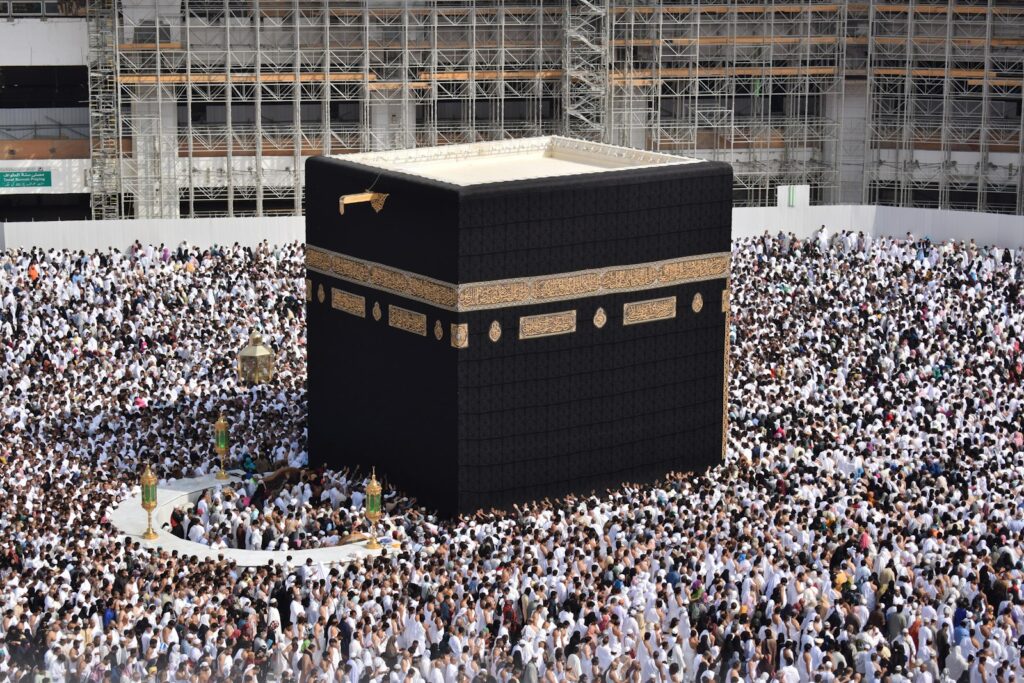
A festival among very different peoples
Eid al-Adha is celebrated in Saudi Arabia and Egypt, but also in Turkey, Pakistan, Bangladesh, and Indonesia, among many other countries. Its presence beyond the Arab world helps reveal Islam’s diversity. In several of these places, the date is a public holiday and part of the public calendar, alongside the activities of families and mosques.
In Indonesia, the festival is known as Idul Adha and includes local traditions of celebration and meat distribution. Muslim communities in countries such as the United Kingdom also maintain family gatherings and offerings, including sending money for sacrifices in other countries. The language, food, and organization change, but the remembrance of Abraham remains at the heart of the festival.
Sacrifice and Jesus, the Lamb of God
The story of a son spared and an animal offered in his place provides an opening for conversation about sacrifice and God’s provision. In the Christian reading of Genesis 22:1-14, the ram dies in Isaac’s place. This passage helps explain the meaning of Jesus’ death, without attributing to Muslims an interpretation that belongs to the Christian faith.
In John’s Gospel, John the Baptist introduces Jesus through an image connected with sacrifice. He points to the Lamb of God and connects his mission with the sin of the world, meaning human disobedience to God. This is a central passage for explaining why Christians find in Jesus the answer to their need for forgiveness:
“Look, the Lamb of God, who takes away the sin of the world!”
John 1:29, NIV
Hebrews 10:10-14 teaches that Jesus offered himself once for all and that his sacrifice for sins has lasting value. For the Christian faith, forgiveness depends on this self-giving of Christ. In explaining this hope, it is necessary to respect the meaning Eid al-Adha holds for Muslims, centered on obedience, devotion, and generosity.
Getting to know those who celebrate and praying for the nations
Eid al-Adha can be an occasion to get to know a Muslim neighbor, colleague, or friend better. Listening to how their family observes the date helps avoid assumptions and makes room for respectful conversation. If there is interest in discussing faith, the story of Abraham can lead to reading Genesis and John’s Gospel, with attention to the differences between the beliefs.
As you pray for the nations during this festival, remember unreached peoples, among whom there are few opportunities to hear and understand the gospel. Ask that Muslim families may have the opportunity to know Jesus and that Christians may explain their faith clearly and kindly. This approach begins by treating each person as someone to get to know and love.
 Missions Is Allah the Same God Christians Worship?
 Missions Christians from Hindu backgrounds in India: faith, family, and anti-conversion laws
 Missions International Day of Prayer for the Persecuted Church