Missions
What Is Ganesh Chaturthi
Explore Ganesh Chaturthi, the Hindu festival of Ganesha: its origins, rituals in homes and streets, and the meaning of immersing images in water, especially in Mumbai.

Ganesh Chaturthi is a Hindu festival celebrating the birth of Ganesha, a deity depicted with an elephant’s head and associated with wisdom, new beginnings, and the removal of obstacles. During the celebration, devotees welcome images of Ganesha into homes and public spaces, pray, and offer food. The farewell takes place through the immersion of these images in water.
The festival is especially important in Maharashtra, the state in western India where Mumbai is located. There, family devotion also fills the streets, with decorated structures, music, and processions. To understand why an image prepared with such care is eventually taken to the sea or a river, it is necessary to understand the meaning of this visit and its farewell. To see how this date fits into the Hindu calendar, read about Hinduism’s most important festivals.
The story of Ganesha and the origins of the public festival
In Hindu tradition, Ganesha is the son of Parvati and Shiva. One account says that Parvati created a son and gave him the task of guarding the entrance to her home. When Shiva returned, the boy blocked his way. In the conflict, Shiva cut off his head, but later restored his life using the head of an elephant.
According to this account, Shiva also granted Ganesha the honor of receiving devotion before the start of important activities. The story connects him with protecting new beginnings and helps explain why the celebration includes requests for wisdom and help in facing obstacles.
There is no certain date for the festival’s beginnings. Its modern public form, however, has an important connection with Bal Gangadhar Tilak, a leader of India’s independence movement. In 1893, he and other organizers in Pune helped expand communal celebrations in Maharashtra, using an existing devotion to bring people together and strengthen unity under British rule.
Why devotees welcome Ganesha
Participants seek Ganesha’s blessing to face difficulties and make a good start in a new stage of life. This may involve studies, work, or a business venture. Ganesha’s association with wisdom helps explain these requests for guidance and blessing on activities that are beginning.
The festival also gives concrete expression to gratitude and family ties. Preparing the image, making offerings, and sharing food involve the household and the community. For devotees, welcoming Ganesha for a few days is an occasion for prayer and hospitality, with a farewell anticipated from the start of the celebration.
From the calendar to the farewell in the water
The celebration begins on the fourth lunar day of the waxing fortnight in the Hindu month of Bhadrapada, generally between August and September. Chaturthi means precisely this fourth day. Since the date follows a calendar that combines the cycles of the Moon and the Sun, it changes from year to year in the calendar used in Brazil.
The festive cycle is usually described as a ten-day celebration, ending on Anant Chaturdashi, the fourteenth lunar day of the same fortnight. Not every family keeps the image throughout this period. In Goa, for example, some household celebrations last a day and a half; other family customs call for a longer stay.
At the beginning, an image is placed on a household altar or in a pandal, a temporary structure erected for the public celebration. During the consecration ceremony, prayers and sacred formulas invoke Ganesha’s presence. For the devotee, the consecrated image becomes a place of encounter with the deity, which explains the care devoted to it.
Over the following days, pujas take place, acts of worship that include prayers and offerings. There is also aarti, a rite in which a flame is moved before the image, accompanied by singing. Flowers, fruit, and sweets are among the offerings, and some participants fast. Practices vary according to the family and religious tradition.
Among the best-known foods is modak, a sweet considered one of Ganesha’s favorites. One version from Maharashtra has a rice-flour dough filled with coconut and unrefined cane sugar and is steamed. In Goa, there are also fried versions. Food that is offered and then shared is called prasad, food received as a blessing.
The farewell is called visarjan, the immersion of the image in water. After a final prayer, the image is carried in procession to the sea, a river, a lake, or a site prepared for the rite. Music, singing, and dancing accompany many of these processions, which may bring together a single family or a large crowd.
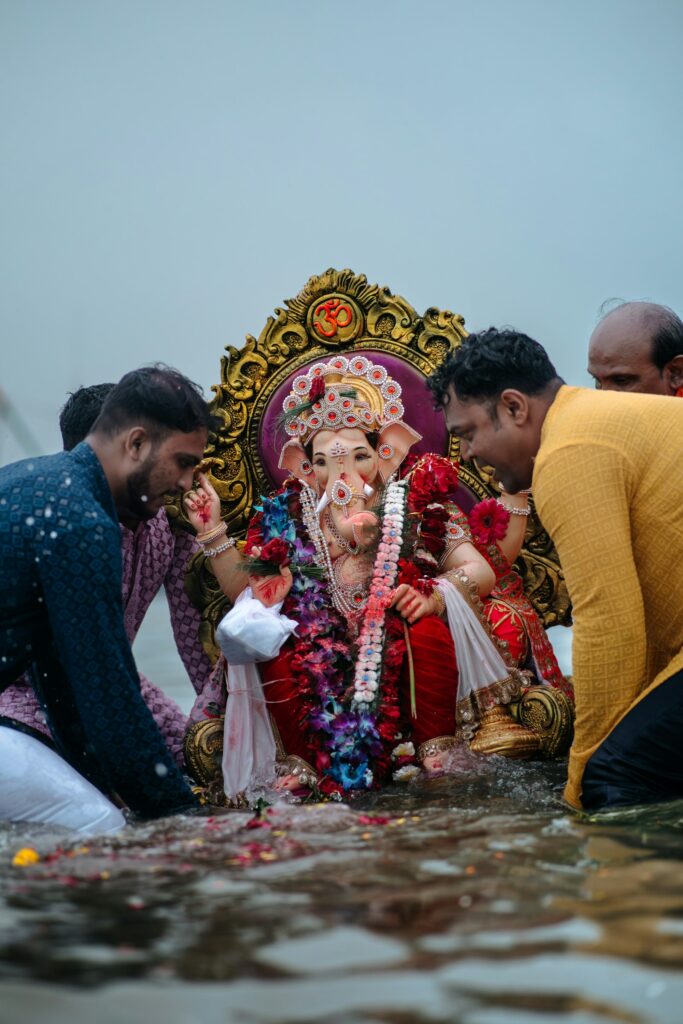
In the religious understanding expressed by many devotees, the farewell symbolizes Ganesha’s return to Mount Kailash, the home of Shiva and Parvati. The clay image dissolves in the water, and participants express their wish to welcome Ganesha again the following year. Immersion is therefore part of the devotion itself, bringing the celebrated visit to a close.
The materials used for the images also raise an environmental issue. Some initiatives encourage clay and natural colors to reduce harm to the water. Mumbai provides artificial tanks for immersion and promotes separate collection of flowers and other materials used in offerings. These measures seek to reconcile the rite with care for the places where celebrations take place.
From Mumbai to communities outside India
Maharashtra is known for its large public celebrations, especially in Mumbai and Pune. Community spaces welcome images and visitors, and programs may include cultural performances as well as worship. The festival thus brings together devotion before the image, the work of organizers, and the participation of those who follow the street processions.
The celebration also takes place in other parts of India, such as Goa, Karnataka, and Andhra Pradesh. In Goa, it is known locally as Chovoth and is celebrated especially in homes. In Karnataka, the previous day is dedicated to Gowri, a name for Parvati, Ganesha’s mother; the two festivals are often observed together, although each has its own rites.
Outside India, Mauritius offers an example of how this tradition accompanies communities of Indian origin. Ganesh Chaturthi is part of the country’s public holiday calendar and is particularly important among people of Marathi origin, who have cultural ties to Maharashtra. There, too, families welcome images and take them to the water at the end of the celebration.
The search for new beginnings and the gospel
The search for wisdom and help in facing difficulties offers a starting point for a respectful conversation about faith. Christians can recognize these needs without assuming they know everything a Hindu family thinks or feels. Listening to the meaning the family gives the festival helps them take its beliefs seriously.
The gospel presents Jesus as the way to the Father, according to John 14:6. The Christian hope of a new beginning is connected with this relationship with God. It also includes trust amid suffering: in John 16:33, Jesus tells his disciples that they will face trouble and offers them peace in him, sustained by his victory over the world.
Getting to know those who celebrate and praying for the nations
For those who pray for the nations, learning about Ganesh Chaturthi helps bring specific people to mind: families who welcome an image into their home, artisans who make the images, and communities that organize processions. Prayer can include Hindus in Maharashtra and Mauritius, Christians who live alongside them, and peoples unreached by the gospel.
This approach can begin with interest in a family’s history and a willingness to listen to their memories of the festival. Pray that Christians may explain who Jesus is with clarity, friendship, and respect, and that those who celebrate may come to know the gospel.
You have read this story. Now pray.
Today we pray for a nation and a people who still need to hear the gospel.
 Missions Veils, hijab and burqa: women in Islam
 Missions 2027 prayer calendar: campaigns and dates for the year
 Missions How to help persecuted Christians beyond prayer