Missions
What Is Holi
Holi is the Hindu festival of colors and spring. Discover the stories of Prahlada, Holika and Krishna, the meaning of the bonfire and how the celebration brings families and communities together.

Holi is a Hindu festival celebrating the arrival of spring, love and the victory of good over evil. Known as the festival of colors, it brings people together to scatter colored powder and splash water on one another. The celebration also includes religious rituals, music, visits and family meals.
To understand Holi, it helps to know what comes before the colorful streets: a bonfire recalling the protection of a boy named Prahlada. Another important story involves Krishna and Radha, associated with love and playful exchanges of color. These traditions help explain why the festival combines devotion and joy. To see how this occasion fits into the Hindu calendar, read about the most important Hindu festivals.
The stories of Prahlada, Holika and Krishna
Holi has its origins in the Hindu traditions of ancient India. Different communities explain the festival through religious stories, and there is no single narrative shared by everyone. Among the best known are the story of Prahlada and Holika and accounts of Krishna’s playful exchanges with Radha.
According to the first account, King Hiranyakashipu demanded that people worship him. His son Prahlada, however, remained devoted to Vishnu, a Hindu deity. The king tried to force the boy to abandon this devotion and, when he refused, sought a way to kill his own son.
Holika, the king’s sister, entered the fire with Prahlada; according to the account, she could withstand fire. The plan was for only the boy to die. In the narrative, the opposite happened: Holika died, and Prahlada was protected by Vishnu. The festival bonfire recalls this outcome as a victory of devotion over violence.
Another account tells how Krishna, a Hindu deity often depicted with blue skin, asked his mother why Radha had lighter skin. She suggested that he put colors on Radha’s face. This playful act became associated with Holi and, for devotees, expresses the love between Krishna and Radha.
Why spring and new beginnings are celebrated
The remembrance of Prahlada teaches worshippers that a ruler’s power does not stand above divine protection. His perseverance is valued because he maintains his devotion even under threat. The bonfire therefore has a religious meaning: it recalls the defeat of evil and the desire to leave harmful attitudes behind.
The cycle of nature also helps explain the festival. In farming communities in northern India, Holi is linked to the arrival of spring and the harvest season. The end of winter provides an occasion to give thanks and celebrate the renewal of life, alongside the meanings found in the religious accounts.
New beginnings also appear in relationships. The festival encourages forgiveness, the renewal of friendships and encounters between people often separated by social differences. This coming together expresses an ideal of harmony. Visiting, embracing and sharing sweets give concrete expression to the desire to start afresh.
From the bonfire night to the day of colors
Holi is linked to the full moon of Phalguna, a month in the Hindu calendar that corresponds to parts of February and March. This calendar combines lunar cycles with the solar year, which is why it is called lunisolar. The date changes in the calendar used in Brazil and usually falls in March.
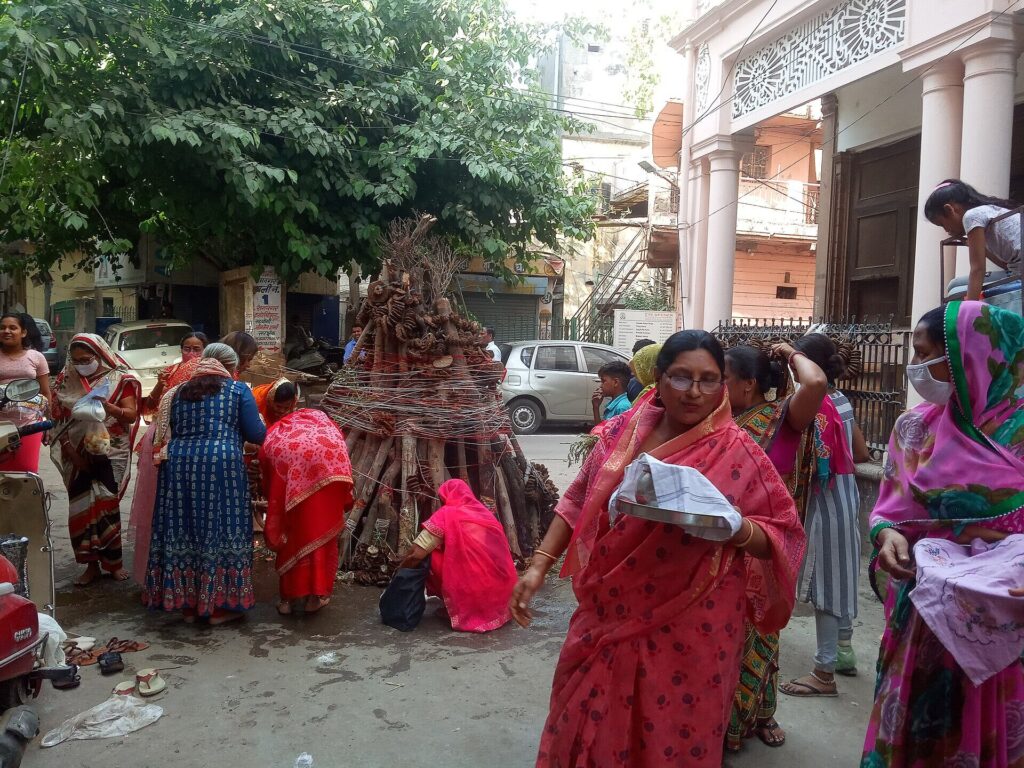
In many communities, the main celebration begins on the night of the full moon with Holika Dahan, the ritual burning that recalls Holika. Families gather around a bonfire, pray and present offerings such as water and grain. In some places, an effigy representing Holika is also burned.
The following day brings the colorful part of Holi. Children and adults smear gulal, the name for the colored powder, on one another’s faces and clothes. They also use colored water, buckets and toys that squirt water. Music, dancing and games accompany gatherings in streets and neighborhoods.
The colors recall Krishna and Radha’s playful exchanges and make the festival’s joyful atmosphere visible. But Holi also includes celebrations inside temples. In communities devoted to Krishna, there are religious songs and decorated images of the deity, showing how public festivities can be connected with devotion.
Food is part of the hospitality. Festival preparations include gujiya, a sweet fried pastry, and thandai, a refreshing drink made with nuts and spices. Recipes vary by place and family. After the games, gatherings continue with sweets, meals and time together.
Local customs also change the length and appearance of the celebrations. In northern India, in places associated with Krishna’s life, festivities feature flower petals as well as powdered colors. Other traditions include religious images on decorated swings and special songs. The sequence of bonfire and colors is a common pattern, but does not encompass every form of Holi.
Where Holi is part of community life
India is the main setting for the celebration, which involves families, temples and public spaces. In Delhi, for example, the festival extends into neighborhoods and public areas. How people take part depends on the community: some focus more on rituals, others on visits and games.
In Nepal, Holi is also part of the public holiday calendar and is known as Fagu Purnima. Observance dates differ between the hill region and the Terai in the south, where the festival usually falls a day later. This shows why it is better to learn about each place’s calendar than to assume the same schedule applies everywhere.
Outside South Asia, the festival is also celebrated in communities of Indian origin. In Trinidad and Tobago, it is called Phagwa and includes singing, dancing and the use of a dye called abir. In the United States, games with colors have also reached universities, drawing participants from different backgrounds and religions.
The desire for reconciliation and the message of Jesus
Holi expresses human desires that a Christian can recognize: for evil to be overcome, relationships to be restored and life to have a new beginning. Understanding these meanings helps us speak respectfully. Those who celebrate may find in the festival family memories, religious commitment and a sense of belonging to a community.
In the Christian faith, forgiveness and reconciliation with God have their foundation in Jesus. In 2 Corinthians 5:18-21, Paul explains that God reconciles people to himself through Christ and entrusts Christians with the message of that reconciliation. Paul says that God made the one who had no sin to be sin for us, so that in him we might become the righteousness of God.
When sharing the gospel, Christians can explain what they believe and listen to what the other person considers important. The conversation calls for care in presenting each tradition faithfully. The desire to overcome conflict offers a subject close to everyday life, through which it is possible to speak about Jesus clearly and respectfully.
Learning about the festival to pray for the nations
Holi reminds us that praying for the nations involves getting to know the people behind the names of countries. In India, Nepal or a community of Indian origin near home, it is worth listening to how each family experiences this season. Asking what the festival means to them helps build a friendship marked by attentiveness and respect.
In prayer, ask that families may come to know the forgiveness offered by Jesus and that Christians may live alongside their neighbors with love and honesty. Remember unreached peoples too, among whom many people have few opportunities to hear an explanation of the gospel. Helping people come to Christ begins with treating each person with dignity.
You have read this story. Now pray.
Today we pray for a nation and a people who still need to hear the gospel.
 Missions Veils, hijab and burqa: women in Islam
 Missions 2027 prayer calendar: campaigns and dates for the year
 Missions How to help persecuted Christians beyond prayer