History
Who were the tax collectors and why were they hated
Learn who the tax collectors were, how they collected taxes, and why Jesus welcomed Matthew and Zacchaeus while calling them to repentance.

The tax collectors collected taxes and duties, especially on goods and their movement. They were looked down on because their work allowed room for abuse and associated people from the local community with the power taxing them. To many, a Jewish tax collector appeared to grow rich at the expense of his own people and to collaborate with foreign rule. This reputation explains the surprise when Jesus called Matthew and stayed with Zacchaeus.
The Gospels show tax collectors being treated as sinners, but they also show Jesus receiving these people and calling them to repentance, a change of direction before God. He did not approve of exploitation. His welcome made room for forgiveness and a different life, without reducing anyone to their profession or reputation.
How tax collection worked
Historical sources help us understand a system the Gospels do not describe in detail. In the Roman world, there were taxes on people and land, as well as duties on goods. Some collection could be contracted out to private individuals: a contractor took on the right to collect and the obligation to pay a sum to the government, seeking a profit from the proceeds.
These contractors could employ local collectors. Researcher Ulrike Malmendier of the University of California, Berkeley, distinguishes the major businessmen called publicani in Latin from the local collection agents mentioned in the Gospels. Thus, the term publican in Bible translations does not necessarily mean a wealthy Roman businessman. The biblical text itself distinguishes Zacchaeus as a chief tax collector.
We also need to distinguish between local governments. In the Galilee of Jesus’ day, Herod Antipas ruled, and duties collected at an office such as the one in Capernaum could support his government. Not every collector personally handed money to the emperor. Forms of collection varied by place and period; we should not imagine a single Roman contract behind every tax collector in the Gospels.
Why tax collectors were hated
There was an economic reason for distrust: the possibility of collecting more than was owed. Valuing goods and dealing directly with those who had to pay left room for abuse. When tax collectors came to John the Baptist, he told them not to collect more than the amount prescribed (Luke 3:12-13). He did not order all of them to leave their profession.
There was also a political reason. Collecting from one’s own neighbors to support authorities tied to Roman rule could seem like betrayal of the community. This helps explain the contempt, but it does not prove that every collector was dishonest. The biblical accounts present specific individuals, and a profession’s bad reputation cannot replace an assessment of each person’s actions.
The religious question requires care. The Mishnah, a collection of Jewish teachings and discussions compiled after the period of the Gospels, records concerns about collectors entering homes (Taharot 7:6). The issue is ritual impurity, a condition related to religious purity rules that does not automatically amount to moral guilt. This later source helps us learn about certain traditions, but it does not describe the views of all Jews in Jesus’ time.
The Mishnah itself records distinctions: in Hagigah 3:6, collectors who entered a house to seize property are considered trustworthy when they say they did not touch the other objects. It would therefore be an exaggeration to say that all were always treated in the same way or were forbidden to enter the temple. In Jesus’ parable, the tax collector goes to the temple to pray (Luke 18:10). Social contempt was real, but it does not justify generalizations.
Jesus called Matthew and welcomed Zacchaeus
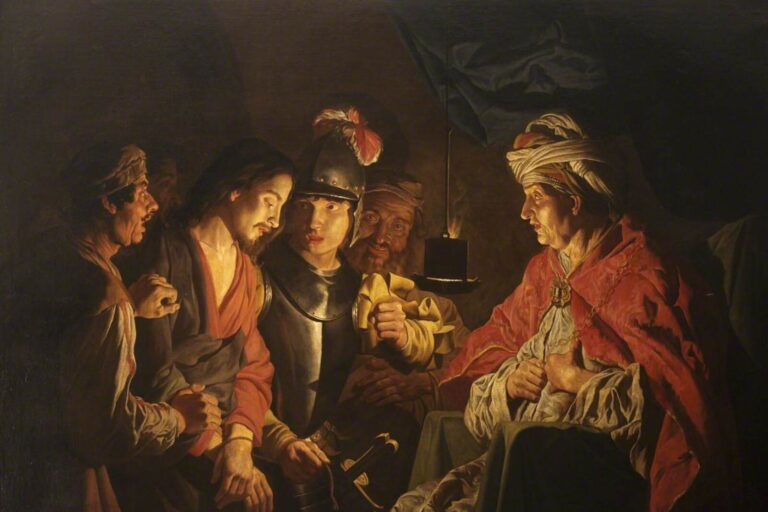
Matthew 9:9 recounts that Jesus saw Matthew sitting at the tax collector’s booth, the place where taxes were collected, and called him to follow. He got up and went with Jesus. Afterward, many tax collectors shared a meal with Jesus and his disciples, prompting a question from the Pharisees about their association (Matthew 9:10-13). The former collector appears among the apostles, the disciples Jesus chose and sent out (Matthew 10:2-3).
Jesus answered the criticism by comparing his mission with the work of a doctor caring for the sick. In Luke 5:27-32, the similar account names the collector as Levi and explicitly states that Jesus came to call sinners to repentance. The meal expressed welcome and closeness. At the same time, the call pointed toward a change of life, without treating sin as unimportant.
In Jericho, Zacchaeus was wealthy and a chief tax collector. He wanted to see Jesus and climbed a tree because of the crowd; Jesus took the initiative by announcing that he would stay at his house. People complained that he was staying with someone considered a sinner. Zacchaeus declared that he gave half his possessions to the poor and would repay four times the amount if he had cheated anyone (Luke 19:1-8).
Scholars debate this declaration: some understand the verbs as a commitment made at that encounter; others understand them as describing a practice Zacchaeus already followed. The text records his willingness to share and make restitution, while Jesus announces salvation and recognizes his place among Abraham’s people (Luke 19:9).
“For the Son of Man came to seek and to save the lost.”
Luke 19:10, NIV
The Pharisee and the tax collector before God
In Luke 18:9-14, Jesus tells a parable, a story used to teach, addressed to those who trusted in their own righteousness and despised others. A Pharisee, a member of a Jewish movement devoted to observing the Law, lists his religious practices and compares himself favorably with the tax collector. The collector stands at a distance, acknowledges his own sin, and asks for mercy.
Jesus states that the tax collector went home justified, meaning accepted as righteous before God. The contrast does not teach that all Pharisees were hypocrites or that dishonesty was acceptable. It shows that no one gains God’s approval by despising another person. The path presented is to recognize our own need and depend on divine mercy, a warning that also applies to Christian readers.
The lesson for today and for the nations
This story calls us to unite welcome and honesty. Those who come to Jesus do not need to hide their past, but they do need to face their actions and put wrongs right. For the church, this means receiving those who carry a difficult reputation, walking alongside them, and not confusing influence, money, or religious appearances with a life that pleases God.
Jesus reached people from different groups: he welcomed tax collectors, responded to a military officer’s request, and accepted an invitation to dine with a Pharisee (Luke 7:1-10,36). Then he sent his disciples to all nations (Matthew 28:19-20). As we pray for unreached peoples, those with little access to the gospel, we can ask that they come to know Jesus and meet Christians willing to listen to their stories, without contempt for their background or social standing.
The encounter with the tax collectors teaches us to proclaim forgiveness and call people to a just life, trusting that Jesus can reach those who seem far away. The same willingness should guide our approach to people of other nations. See also the other groups from the time of Jesus.
 History Who were the Sadducees?
 History Who were the Samaritans and why did Jews and Samaritans not get along
 History Who were the Zealots