Exiled Hebrew - Administrator of Babylon - Faithful in the furnace

Shadrach

PeriodBabylonian exile, ~605-536 BC
Summary
Shadrach was one of three Hebrew friends exiled to Babylon alongside Daniel, promoted to administrator and later thrown into a blazing furnace for refusing to worship Nebuchadnezzar's golden statue. His faith in the face of certain death became one of the greatest testimonies of courage in Scripture.
Who was Shadrach
Biography

Almost everyone has felt the pressure of being the only one to disagree. A whole crowd applauds something wrong, and standing alone feels more dangerous than sitting down and going along. Shadrach’s story begins in exactly that moment, multiplied by a death threat.

His birth name was Hananiah. While still young, he was carried off into exile from Judah to Babylon, when Nebuchadnezzar invaded Judah and besieged Jerusalem. Along with Daniel, Meshach, and Abednego, he was chosen to serve at the imperial court and was given a new pagan name: Shadrach (Daniel 1:6-7).

Even far from home, he and his three friends refused to defile themselves with food from the king’s table, and God blessed them with wisdom above all the wise men of Babylon (Daniel 1:8-20). In time, Shadrach was promoted to administrator over an entire province (Daniel 2:49).

The real test came when the king set up a golden statue and ordered everyone to bow down to it at the sound of music. Shadrach, Meshach, and Abednego remained standing, alone amid an entire crowd (Daniel 3:1-12).

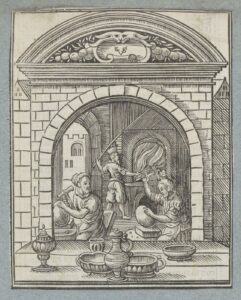
Accused and brought before a furious Nebuchadnezzar, they answered without hesitation: their God was able to deliver them from the furnace, but even if he did not, they would not worship another god (Daniel 3:16-18). They were thrown into a fire heated seven times hotter than usual.

Nebuchadnezzar saw four men walking unharmed in the flames. When Shadrach came out, there was not even a smell of smoke on his clothes (Daniel 3:24-27). The pagan king himself ended up glorifying the God who had saved them.

Shadrach’s faith did not depend on a guaranteed outcome. He obeyed God knowing he might die for it. It is this kind of trust, willing to burn if it must, that still calls every reader to decide before what they will bow down today.
Defining verses

Shadrach, Meshach and Abednego replied to the king, "King Nebuchadnezzar, we do not need to defend ourselves before you in this matter. If we are thrown into the blazing furnace, the God we serve is able to deliver us from it, and he will deliver us from Your Majesty's hand. But even if he does not, we want you to know, Your Majesty, that we will not serve your gods or worship the image of gold you have set up."

Daniel 3:16-18

He said, "Look! I see four men walking around in the fire, unbound and unharmed, and the fourth looks like a son of the gods."

Daniel 3:25

Visions, prophecies, and deeds

Taken into exile and renamed

Nebuchadnezzar takes noble young men from Judah to Babylon; Hananiah receives the Babylonian name Shadrach.

Daniel 1:1-7

Refusal of the king's food

Along with his three friends, he chooses not to defile himself with the royal table and is blessed with health and wisdom.

Daniel 1:8-20

Promoted to administrator of Babylon

At Daniel's request, the king places him in charge of the affairs of the province of Babylon.

Daniel 2:49

Refusal to worship the golden statue

When the entire crowd bows down before the image set up by Nebuchadnezzar, Shadrach remains standing.

Daniel 3:1-12

Declaration of faith before the furnace

Before the furious king, he states that God can deliver him, but that he will obey even if God does not.

Daniel 3:16-18

Deliverance in the blazing furnace

Thrown into a fire heated seven times hotter than usual, he comes out unharmed, without even the smell of smoke on his clothes.

Daniel 3:19-27

Public recognition by the pagan king

Nebuchadnezzar glorifies Shadrach's God and decrees punishment for anyone who speaks against him.

Daniel 3:28-30
Timeline
~605 BC

Babylonian exile and change of name

Nebuchadnezzar takes noble young men from Judah, including Hananiah, to Babylon, where he is given the name Shadrach (Daniel 1:1-7)

~605 BC

The ten-day test

He refuses to defile himself with the king's food, along with Daniel, Meshach, and Abednego (Daniel 1:8-16)

~603 BC

Promoted to administrator

At Daniel's request, he is placed in charge of the affairs of the province of Babylon (Daniel 2:49)

date uncertain

The golden statue

Nebuchadnezzar sets up a golden image and orders everyone to worship it (Daniel 3:1-7)

date uncertain

Thrown into the furnace

He refuses to bow down before the image and is thrown into the blazing furnace (Daniel 3:8-23)

date uncertain

Miraculous deliverance

He comes out of the fire unharmed, without even the smell of smoke, before the king and the whole court (Daniel 3:24-30)

Portrait

Unshakable faithfulness to God even under threat of death (Daniel 3:16-18)

Courage to stand firm alone, against an entire bowing crowd (Daniel 3:12)

Faith that did not require a guarantee of rescue, willing to trust even without the expected outcome (Daniel 3:18)

Integrity sustained from a young age, refusing to defile himself with what came from the king's table (Daniel 1:8-16)

Competence recognized by the court, promoted to a position of administrative trust (Daniel 2:49)

Lessons and legacy
Lessons from their life

It is possible to remain faithful even when no one else around you does the same

God may choose to act differently than we expect, but obedience cannot depend on the outcome

Adversity is often the setting where faith becomes most visible and most strong

Faithfulness in small decisions, like food, prepares the character for faithfulness in great trials

Missionary legacy

His confession before the furnace, able to deliver or not, continues to inspire persecuted Christians in contexts of risk for their faith today

It shows that God raises up faithful witnesses even in foreign lands hostile to the gospel, as happens in many mission fields

He represents the exile who flourishes and influences the surrounding culture without conforming to it, a model for anyone living as a foreigner among another people

His story is still used today to encourage Christian minorities facing social or state pressure to abandon their faith

Family and context
Family and relationships
Hebrew name Hananiah (Daniel 1:6-7)
Friends Meshach and Abednego, fellow exiles (Daniel 1:7)
Contemporary Daniel, fellow exile from Judah, one of four young men chosen for the court (Daniel 1:6)
King of the time Nebuchadnezzar, monarch of Babylon (Daniel 3)
Nations mentioned

Israel

Daniel 1:1-2 (Judah)

Iraq

Daniel 1:1-7 (Babylon)

Related places

Judah

homeland, from which he was taken into exile (present-day Israel)

Babylon

capital of the empire to which he was exiled (present-day Iraq)

Court of Nebuchadnezzar

place of his training and his administrative post

Plain of Dura

where the golden statue was set up and the furnace burned (Daniel 3:1)

Where to find them in the Bible

Shadrach's story is recorded in Daniel 1, 2, and 3. He is also mentioned in Daniel 3:28-30, when King Nebuchadnezzar publicly acknowledges the power of the God he served.

Other people