History
Priests and the high priest in the time of Jesus
Explore the priestly divisions, the roles of Annas and Caiaphas, and why Hebrews presents Jesus as high priest forever.

The priests in Jesus’ time oversaw worship in the temple in Jerusalem: they presented offerings, burned incense, and taught God’s Law. The high priest had overall responsibility for this service and represented the people before God. Under Roman rule, the office also carried political weight: Roman authorities could appoint and remove those who held it.
Zechariah, Annas, and Caiaphas illustrate different aspects of the priesthood, the service performed by priests. Understanding their roles helps us understand the Gospels and the message of Hebrews about Jesus, the high priest who lives forever.
Who were the priests, and how did their divisions work?
According to Exodus 28:1, God set apart Aaron and his sons for priestly service. This was a role tied to family descent. Numbers 18:1-7 distinguishes the priests from the other Levites, members of the tribe of Levi who assisted in the service of the sanctuary, the place set apart for worship.
Their work involved sacrifices, offerings presented to God according to his Law. Some offerings concerned sin, while others expressed thanksgiving and fellowship in a relationship with God (Leviticus 4:27-31; 7:11-15). The priests also taught the commandments and distinguished between the clean and the unclean, conditions governing participation in worship under the Law (Leviticus 10:10-11).
Service was organized into divisions, groups that took turns. This arrangement appears in 1 Chronicles 24:1-19, which includes the division of Abijah. Luke 1:5-23 introduces Zechariah, the father of John the Baptist, as a priest from that division: during his turn of service, he was chosen by lot to offer incense, an aromatic substance burned in worship. While he served, the people prayed outside.
The high priest between the temple and Rome
One of the high priest’s responsibilities was the Day of Atonement, an annual occasion devoted to dealing with sin and purifying the sanctuary. Leviticus 16 directs him to enter the Most Holy Place, the innermost part of the sanctuary, carrying blood from the sacrifices. Before representing the people, he had to present an offering for his own sins. He too needed forgiveness.
Outside the Bible, the Jewish historian Flavius Josephus records Roman interference in these appointments. In Jewish Antiquities 18.33-35, he recounts that Valerius Gratus removed Annas and, after several other holders of the office, appointed Joseph Caiaphas. In this context, saying that the high priest was appointed by Rome therefore means that a Roman representative could decide who would serve in that role.
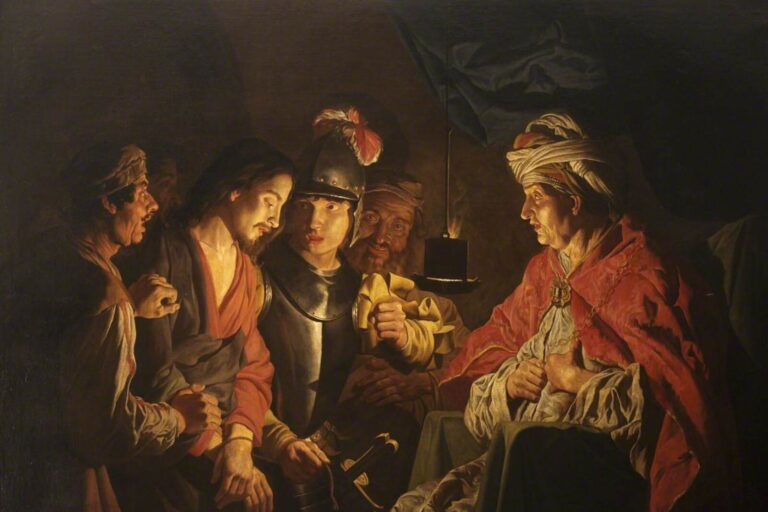
In the Gospels, Caiaphas holds the office, while Annas, his father-in-law, continues to appear as a figure of authority (John 18:13-24). The expression chief priests refers to the priestly leadership, including former high priests and members of their families, as historian Helen Bond explains. It should not be understood as referring to all the priests who served in divisions.
Annas, Caiaphas, and opposition to Jesus
John 11:47-53 recounts that the chief priests and the Pharisees, a group devoted to interpreting the Law, feared Roman intervention because of Jesus. Caiaphas argued that it would be better for one man to die for the people. John explains that, beyond Caiaphas’ intention, those words also foretold Jesus’ death to gather together God’s scattered children.
After his arrest, Jesus was taken first to Annas and then to Caiaphas (John 18:12-24). Pilate, the Roman governor, handed him over to be crucified (John 19:12-16). Scholars debate the formal status of the hearings before the Jewish leadership, as Helen Bond notes.
The opposition of these leaders does not justify blaming the entire Jewish people for Jesus’ death or considering every priest corrupt. Luke describes Zechariah and Elizabeth as righteous before God (Luke 1:5-6). Acts 6:7 adds that many priests became obedient to the faith. The Bible itself rules out passing the same judgment on an entire category of people.
Why is Jesus called high priest?
Jesus did not hold this office in the temple. Hebrews 7:13-17 acknowledges that he belonged to the tribe of Judah and explains his priesthood through God’s promise, according to the order of Melchizedek, that is, following the pattern of this king and priest presented in Scripture. The comparison points to a service that does not depend on descent from Aaron and lasts forever.
“but because Jesus lives forever, he has a permanent priesthood.”
Hebrews 7:24, NIV
The priests were mortal and needed successors. Jesus remains alive and intercedes for those who come to God through him, meaning that he acts on their behalf before the Father (Hebrews 7:23-25). His authority does not depend on a ruler’s choice, and death does not interrupt his service.
Nor did he present an animal or need to offer a sacrifice for sin of his own: he offered himself once for all (Hebrews 7:26-27). Hebrews 9:11-14 explains that his blood cleanses the conscience so that we may serve God. We can therefore seek his help with confidence: he knows our weaknesses and remained without sin (Hebrews 4:14-16).
Hebrews 10:1-4 describes the sacrifices of the Law as a shadow of the good things to come, a foreshadowing of Jesus’ work. The repeated offerings served as a reminder of the reality of sin; in Christ, his single offering opens the way for us to live close to God.
What does this teach us today and about the nations?
Understanding these differences teaches us to see people before judging groups. The Gospels also show that Jesus spoke with Nicodemus, a Pharisee, welcomed Zacchaeus, a chief tax collector, and praised the faith of a centurion, an officer who commanded soldiers (John 3:1-3; Luke 19:1-10; Matthew 8:5-13). His reach crossed religious and social divisions; many priests also embraced the gospel.
This hope guides our prayer for unreached peoples, those with little access to the gospel: that they may know Jesus and find people who will explain his Word in a language they understand. We can begin by welcoming people of another religion and listening respectfully to their questions, without reducing anyone to a label. See also the other groups of Jesus’ time.
 History Who were the tax collectors and why were they hated
 History Who were the Sadducees?
 History Who were the Samaritans and why did Jews and Samaritans not get along