Missions
The most important Buddhist festivals
Discover Losar, Magha Puja, Vesak and Obon: their origins, customs and what these festivals mean to those who celebrate them.

Losar, Magha Puja, Vesak and Obon reflect different aspects of Buddhist life: the desire for a fresh start, the practice of the Buddha’s teachings and remembrance of the dead. The festivals bring together prayers, temple visits, generosity and family gatherings. Their calendars vary across countries and traditions, often following the phases of the Moon. The sequence below runs from celebrations that usually fall in February or March through to Obon, celebrated during the Japanese summer.
Losar: Tibetan New Year
Losar begins on the first day of the first month of the Tibetan calendar, which combines lunar and solar cycles. The main Tibetan celebration usually falls in February or March, although other communities have their own dates. Its roots predate the arrival of Buddhism in Tibet and are linked to Bön, a Tibetan religious tradition. Over time, the festival incorporated Buddhist teachings and ceremonies, making the start of the year a time of purification and wishes for well-being.
Families clean their homes, prepare offerings and welcome relatives with special foods such as khapse, pieces of fried dough. In monasteries, monks read religious texts and take part in chanting and ceremonies; some communities also perform masked dances. The prayers express gratitude, requests for protection and the desire to leave difficulties behind. The festival is observed in Tibet, Bhutan, Nepal and Ladakh, India, with customs differing from one community to another.
Magha Puja: teaching and community
Magha Puja commemorates a gathering of the Buddha and disciples who, according to tradition, arrived without being summoned. On that occasion, he set out guidance for life: avoid evil, do good and purify the mind. The festival is prominent in Theravada Buddhism, one of the main Buddhist traditions. In Thailand, according to most sources, the annual celebration was established at the royal court in the mid-nineteenth century and later spread to the wider population. The event it commemorates is much older than today’s customs.
In Thailand, the date follows the full moon of the third month of the traditional lunar calendar, in February or March, with adjustments in some years. Worshippers offer food to monks, listen to teachings and meditate; at night, they walk around the temple carrying candles, flowers and incense. Food offerings help support the monks, who devote their lives to religious practice and teaching. Laos and Cambodia also celebrate the occasion, and Sri Lanka maintains a related observance with its own customs.
Vesak: the Buddha’s life and the search for liberation
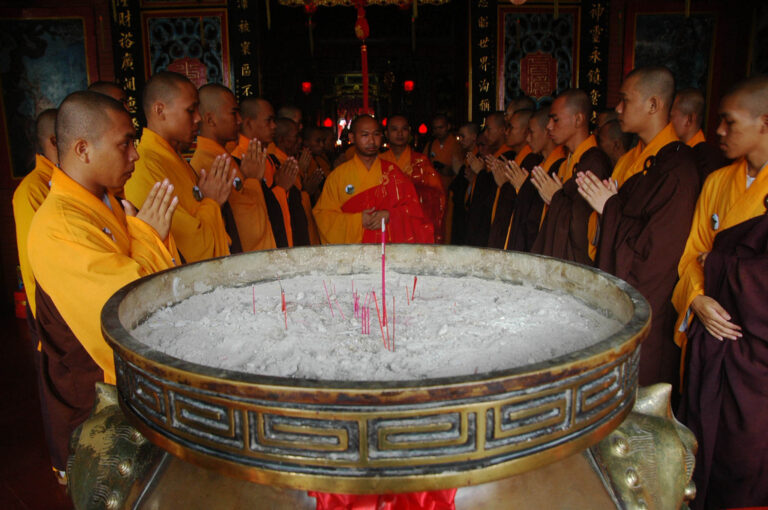
Vesak brings together remembrance of the birth, enlightenment and death of Siddhartha Gautama, known as the Buddha. According to the tradition that links these events, they occurred on the same lunar date in different years. In this context, enlightenment means understanding the human condition and the path to liberation from suffering. The festival has ancient roots, recorded in a Buddhist chronicle from Sri Lanka, and follows the full moon of the month of Vaisakha, usually in May and sometimes in June.
Temple visits, meditation and food offerings renew the commitment to put the Buddha’s teachings into practice. In Sri Lanka, lanterns light the streets and stalls distribute free food and drink; in Thailand, there are candlelit processions. In Myanmar, worshippers water trees associated with the one under which the Buddha is said to have attained enlightenment. The light recalls this awakening, and giving puts generosity into practice; some East Asian traditions commemorate the events of the Buddha’s life on separate days.
Obon: remembering family members who have died
Obon grew out of the meeting of Buddhist ceremonies and Japanese customs honoring the dead. A story associated with the festival tells how Mokuren, a disciple of the Buddha, made offerings to monks to relieve his deceased mother’s suffering and danced with joy when she was freed. The traditional date is linked to the middle of the seventh month of the old Japanese calendar. Today, much of Japan celebrates in August, some places in July, while Okinawa follows the traditional calendar.
Families visit and clean graves, prepare offerings and return to their hometowns to meet relatives. According to a widespread belief, the spirits of family members return home during this period, and the lights represent welcome and farewell, although interpretations vary among Buddhist traditions. Bon odori, a communal dance, also brings the community together at festivals open to the public. Obon expresses gratitude to earlier generations and continues among communities of Japanese descent outside Japan, including in Brazil.
Understanding the festivals and praying for the nations
These celebrations help us get to know real people: Tibetan families welcoming the new year, Thai Buddhists visiting temples and Japanese people remembering their dead. When talking with someone who takes part, ask how their family observes the festival and what it means to them. Listening to these stories helps us understand their beliefs and build a friendship that continues after the celebration.
As you pray for the nations, ask that these families may come to know Jesus and that Christians among them may have wisdom to explain their faith clearly and respectfully. Remember unreached peoples too, communities with little access to the gospel, so that they may come to know its message in their own language. Caring for those who suffer and listening to those who miss their loved ones can be part of sharing life together.
You have read this story. Now pray.
Today we pray for a nation and a people who still need to hear the gospel.
 Missions What Is Yom Kippur
 Missions What Is Vaisakhi
 Missions What Is Vesak