Missions
The most important Sikh festivals
Discover Vaisakhi, Bandi Chhor Divas and Guru Nanak Gurpurab: their origins, their place in the Sikh calendar and the meaning of the celebrations.

Sikh festivals bring together Sikhs, the followers of this religion, to remember their spiritual teachers, hear their teachings and serve others. The main festivals include Vaisakhi, Bandi Chhor Divas and Guru Nanak Gurpurab. Prayers, hymn singing and free meals are part of these celebrations.
The calendar draws on different systems: Vaisakhi follows a solar month, while the other two festivals follow the phases of the moon and change dates in the calendar used in Brazil. The sequence below presents the essentials of each celebration, from commemorating the Khalsa, the community of initiated Sikhs, to the birth of the faith’s founder.
Vaisakhi: the founding of the Khalsa
Celebrated in April, Vaisakhi was already a harvest festival in Punjab, a region now divided between India and Pakistan, before it acquired its Sikh significance. It was on this occasion that Guru Gobind Singh, one of the religion’s spiritual teachers, founded the Khalsa. Its members undergo voluntary initiation and commit themselves to living with discipline, honesty and equality, confronting injustice and protecting those who suffer religious persecution. For Sikhs, the festival is an opportunity to renew these responsibilities.
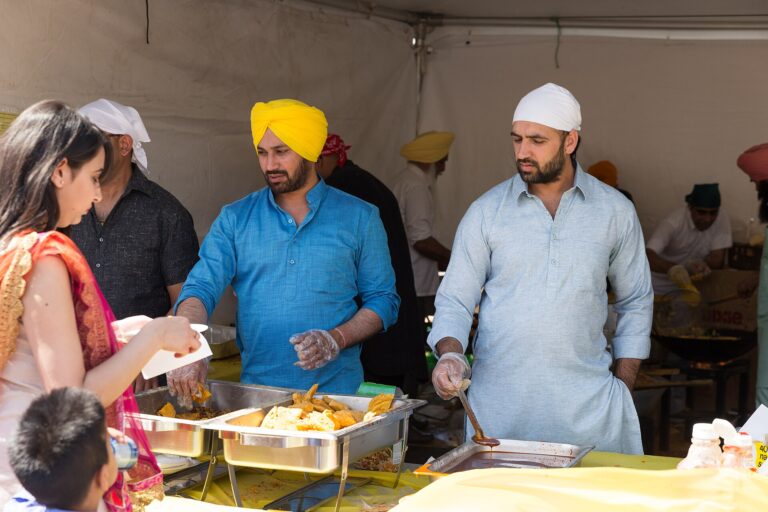
The date marks the beginning of Vaisakh, a month in a solar calendar; in the Sikh Nanakshahi calendar, the year begins in March. Families visit the gurdwara, the Sikh place of prayer and gathering, to hear the scriptures and sing hymns. There are also processions, and initiations into the Khalsa may take place. The langar, the community kitchen that offers free meals to everyone, expresses service to others. Not every Sikh has undergone initiation, but everyone can take part in the meals and other activities.
Bandi Chhor Divas: freedom for prisoners
Bandi Chhor Divas commemorates Guru Hargobind’s release from Gwalior Fort in India. According to Sikh tradition, he refused to leave without the other prisoners. The emperor allowed those who could hold on to the guru’s clothing to leave, so the guru had a cloak with strips prepared for them all. The festival’s name means day of the prisoners’ release. Its meaning lies in responsibility for those who suffer injustice and in using one’s own freedom to help others.
The celebration follows the new moon of Kartik, usually in October or November, alongside Diwali. The calendar combines lunar cycles with the solar year. Gurdwaras hold prayers, hymn singing, teaching about Hargobind and community meals. Families light candles and small lamps and share sweets. In Amritsar, India, the illuminated Golden Temple is a familiar image of the festival. Tradition associates these lights with joy at the guru’s return, while the celebration calls people to service and justice.
Guru Nanak Gurpurab: the founder’s birth
Guru Nanak Gurpurab celebrates the birth of the founder of Sikhism in what is now Pakistan. Gurpurab is the name given to commemorations connected with the life of a guru. Nanak taught about one God, equality among people, honest work and sharing with others. The festival recalls these teachings and traditionally follows the full moon of Kartik, usually in November. Some also commemorate the birth in April, so the schedule depends on the calendar adopted by the community.
In many places, gatherings last about three days and include processions, hymns and prayer. A central practice is the complete, uninterrupted reading of the Guru Granth Sahib, the scripture that Sikhs recognize as their permanent guru. Readers take turns throughout the day and night. In the langar, volunteers cook, serve and wash dishes; people of any religion or social standing receive the meal free of charge. Eating together and receiving the same food makes the equality taught by Nanak visible.
Getting to know Sikhs and praying for the nations
Learning about these festivals helps us remember Sikh families in India, Pakistan and communities in other countries. As we pray for the nations and for unreached peoples with little access to the gospel, we can ask that they have opportunities to know Jesus. We can also pray that Christians who live alongside them will know how to listen, serve and explain their faith clearly.
A conversation can begin with what the festival means to a family or with the work of the volunteers who prepare the meals. When visiting a gurdwara, covering your head, removing your shoes and following your hosts’ guidance shows respect. Listening attentively and building friendships go hand in hand with the commitment to share the gospel.
You have read this story. Now pray.
Today we pray for a nation and a people who still need to hear the gospel.
 Missions What Is Yom Kippur
 Missions What Is Vaisakhi
 Missions What Is Vesak