


 +161
Region · Central America
Christian-majority islands where faith is often mixed with practices like voodoo and Santería; the challenge is discipleship that transforms lives.


The 28 flags of the region. Tap one to open the country.
Largest unreached peoples:
 Deaf 124K
 South Asian 42K
 Muslim Lebanese Arab 21K
Source: Joshua Project and Progress.Bible. Estimates, may vary. Compiled from the data of each country in this region.
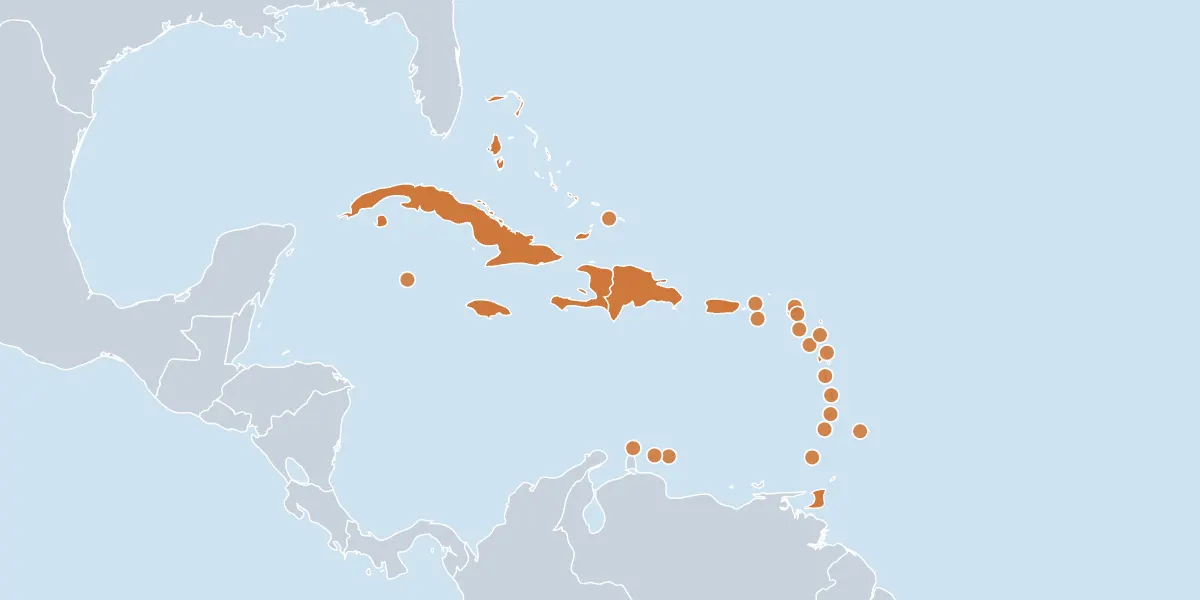
The Caribbean comprises 28 countries and territories scattered across thousands of islands between Central America and South America, from Cuba and Jamaica to small territories such as Aruba, Curaçao and Anguilla. It is a region shaped by a blend of African, European and Indigenous Taíno heritage, a result of the trafficking of enslaved people brought to work on colonial plantations.
Colonial diversity left deep religious marks: alongside French and Spanish Catholicism and British and Dutch Protestantism, Afro-Caribbean religions born from the blending of African traditions and Catholicism survive. Evangelicals account for 16.7% of the Caribbean population, with considerable variation from one island to another.
Despite its many countries, the region is home to 61 people groups, of which 9 are still considered unreached. Of the 128 languages spoken in the Caribbean, including Creole languages, English, French, Spanish and Dutch, 40 still have no part of the Bible translated, many of them Creoles spoken by specific communities on a single island.
Pray for this archipelago of multiple identities, where each island carries its own history of faith and resilience, that the gospel may also reach Creole languages and communities still without Scripture in their own speech.
The trafficking of enslaved people during the colonial period profoundly shaped Caribbean culture and spirituality.
English, French, Spanish and Dutch coexist with dozens of Creole languages unique to each island.
Traditions born from the blending of Catholicism and African spirituality remain alive on several islands.
One of the regions with the highest numbers of countries per unit of land area among all American subregions.
Many are Creole languages specific to small communities isolated on their own islands.
 Anguilla
 Antigua and Barbuda
 Aruba
 Bahamas
 Barbados
 Bonaire
 British Virgin Islands
 Cayman Islands
Cuba
 Curaçao
 Dominica
 Dominican Republic
 Grenada
 Guadeloupe
Haiti
Jamaica
 Martinique
 Montserrat
 Puerto Rico
 Saint Barthélemy
 Saint Kitts and Nevis
 Saint Lucia
 Saint Martin
 Saint Vincent and the Grenadines
 Sint Maarten
 Trinidad and Tobago
 Turks and Caicos
 United States Virgin Islands
Subregions: Greater Antilles · Lesser Antilles
+161
27.5M27.5M people152152 unreached locations


 +44
10.8M10.8M people3939 unreached locations


 +30
5.4M5.4M people3030 unreached locations
+4
113K113K people33 unreached locations


 +25
2M2M people2424 unreached locations


 +10
188K188K people1313 unreached locations